Navy Blue vs Black T-Shirt: This Color Mistake Cost 800 Pieces

In the fast-paced world of bulk plain t-shirt manufacturing and wholesale distribution, even the smallest mistake can lead to significant financial losses and damaged business relationships. Recently, one of our repeat customers at Sale91.com faced exactly this situation when an 800-piece order got mixed up due to color confusion. The culprit? Not following proper color codes when placing the order.
This incident highlights a critical yet often overlooked aspect of the B2B t-shirt business: the importance of standardized color coding systems. What seems like a simple matter of "navy blue" versus "black" can turn into a logistical nightmare when you're dealing with hundreds or thousands of pieces, warehouse lighting conditions, and the subtle variations in how different people perceive colors.
The 800-Piece Color Confusion: What Actually Happened
The customer in question was not new to us. He had successfully placed several orders before and was familiar with our product range. This time, he needed 800 plain t-shirts in four different colors for his custom printing business. The order seemed straightforward enough—he sent his requirements via WhatsApp, specifying the quantities and writing down the color names: "navy blue," "black," "charcoal," and "dark grey."
Our warehouse team processed the order based on these color names. However, when the shipment reached the customer, he immediately raised a concern: instead of navy blue, he claimed he received black t-shirts. Similarly, what he expected as charcoal appeared to be dark grey to him, or vice versa. The problem was that without specific color codes, the interpretation of these color names varied between what the customer had in mind and what our team understood.
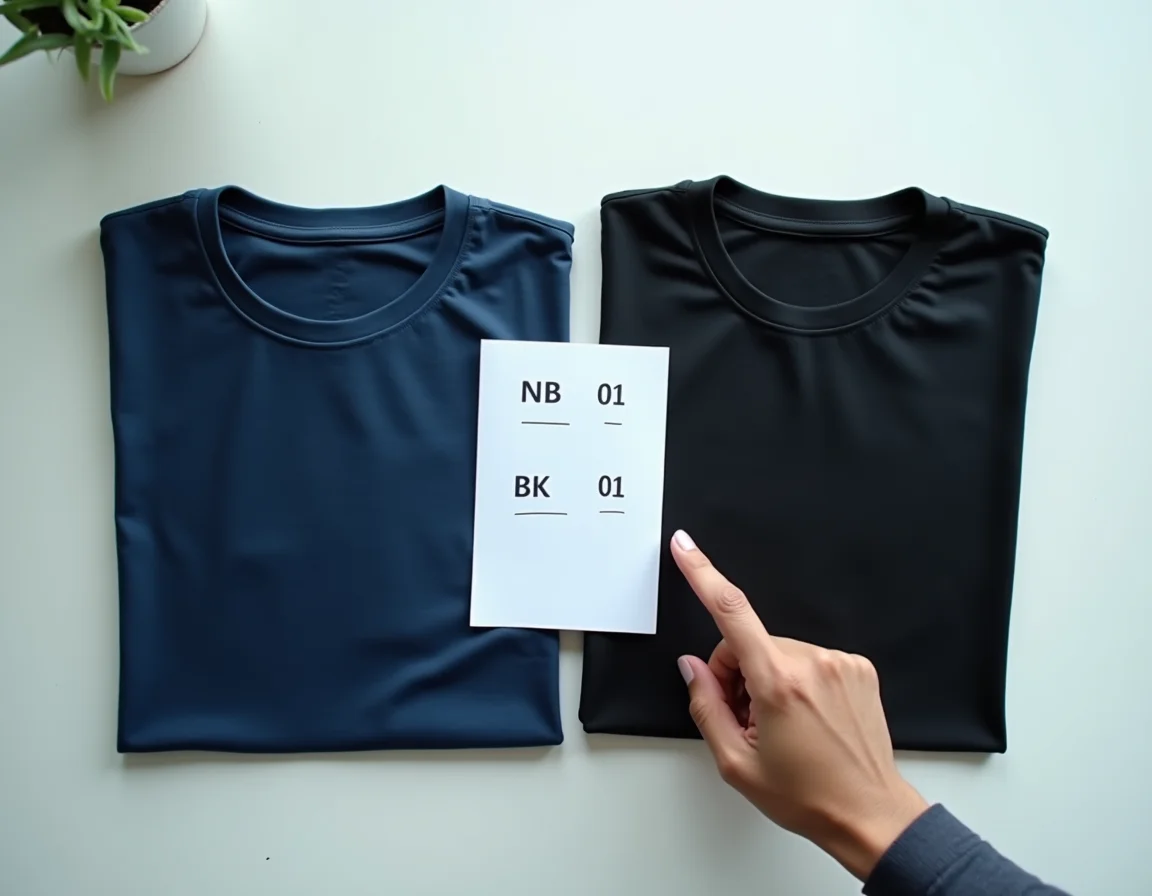
The Core Issue: Navy blue and black look nearly identical when t-shirts are folded and stacked. Under warehouse artificial lighting, the subtle blue undertone in navy completely disappears, making it almost impossible to distinguish from pure black without proper labeling.
Why Color Names Are Not Enough in Bulk Orders
When you're ordering a single t-shirt for personal use from an e-commerce website, selecting "navy blue" from a dropdown menu might work perfectly fine. But in the B2B wholesale plain t-shirt business, where orders range from 100 to 10,000 pieces, relying solely on color names is a recipe for disaster. Here's why:
1. Subjective Color Perception
Color perception is highly subjective. What one person calls "navy blue" might be what another person considers "midnight blue" or even "dark blue." This subjectivity becomes even more pronounced when dealing with similar dark shades. The human eye can distinguish millions of colors, but when it comes to naming them, our vocabulary is limited and varies from person to person.
2. Lighting Conditions Matter Tremendously
In a warehouse environment with artificial fluorescent or LED lighting, dark colors lose their distinguishing characteristics. Navy blue, which has a subtle blue undertone, appears almost identical to black under certain lighting conditions. Similarly, charcoal grey and dark grey can be virtually indistinguishable when t-shirts are folded and stacked in bulk.
3. Multiple Color Variations in Stock
At Sale91.com, we maintain ready stock of over 1 lakh plain t-shirts at any given time in 15+ colors. Within what customers generally call "blue," we have multiple variations: sky blue, royal blue, navy blue, and dark blue. Each serves a different market need, and each has its own specific code. Without using these codes, there's always room for error.
4. Manufacturing Lot Variations
Even with the same color name, different manufacturing batches can have slight variations in shade. This is a reality of textile manufacturing, even with strict quality controls. Color codes help ensure that customers receive exactly the same shade they ordered previously, as the code is linked to specific dye formulations and manufacturing processes.
The Color Code System: Your Best Defense Against Mix-Ups
Every professional plain t-shirt manufacturer assigns unique codes to each color in their catalog. At Sale91.com, our color coding system is designed to eliminate ambiguity completely. For example:
- NB-01: Navy Blue
- BK-01: Black
- CG-01: Charcoal Grey
- DG-01: Dark Grey
- WH-01: White
- RB-01: Royal Blue
These codes are not arbitrary. They're systematically assigned and maintained across our inventory management system, linking directly to specific dye lots, fabric batches, and production runs. When you order using these codes, there's zero room for interpretation—you get exactly what the code represents.
How Color Codes Work in Practice
When a customer places an order at Sale91.com using proper color codes, here's what happens behind the scenes:
- The order entry system recognizes the exact color code and links it to the specific SKU in our inventory
- Warehouse staff receive pick lists with both the color code and name for verification
- Each bundle of t-shirts is labeled with the color code during storage
- During packing, a final verification check matches the color code on the product with the order requirement
- The invoice clearly mentions both the color name and code for customer reference
This systematic approach has helped us achieve a near-zero error rate in color fulfillment for customers who consistently use our color coding system.
Practical Tips for Repeat Customers: Build Your Own Color Reference System
If you're running a custom printing business and regularly order bulk plain t-shirts from manufacturers like Sale91.com, implementing a simple color reference system can save you from costly mistakes and wasted time. Here's a practical, foolproof method:
Step 1: Create a Physical Color Reference Library
When your first order arrives, set aside one piece of each color you've ordered. Don't use these for printing or resale. These are your reference pieces. Use a permanent marker or fabric pen to write the following on the inside label of each reference t-shirt:
- The manufacturer's color code (e.g., NB-01)
- The color name as you understand it
- The order date
- The invoice number for future reference
Store these reference t-shirts in a clean, dry place where they won't fade or get dirty. When placing your next order, you can physically match new requirements against these references.
Step 2: Maintain a Digital Color Log
Create a simple spreadsheet or note on your phone with columns for:
- Color code from the manufacturer
- Color name
- Your internal reference (if you use your own naming system)
- Last ordered date
- Typical use cases (e.g., "corporate orders," "college events," etc.)
This digital log becomes especially useful when placing orders remotely or when discussing requirements with clients. You can quickly reference exactly what you need without ambiguity.

Step 3: Always Reference Previous Invoice Numbers
When placing repeat orders, mention your previous invoice number in your purchase order or communication. This allows the manufacturer to pull up your exact previous order details, including the specific color codes you received. At Sale91.com, our customer service team can quickly reference past orders and confirm that you're ordering the same colors as before.
Step 4: Communicate in Codes, Not Just Names
Make it a business practice to always use both the color name and code when placing orders. For example, instead of writing "Need 200 navy blue t-shirts," write "Need 200 navy blue (NB-01) t-shirts." This dual referencing adds an extra layer of verification and dramatically reduces the chance of errors.
Understanding Dark Color Challenges in the T-Shirt Business
The confusion between navy blue and black, or between charcoal and dark grey, is not unique to one customer or one manufacturer. It's a industry-wide challenge that stems from the nature of dark colors themselves and how they're produced in textile manufacturing.
The Science Behind Color Perception
Dark colors absorb most light wavelengths, reflecting very little back to our eyes. This is why they appear "dark" in the first place. But this also means that the subtle differences between similar dark shades—like the blue undertone in navy versus the neutral tone in black—are much harder for our eyes to detect, especially in poor lighting.
When t-shirts are folded with only a small portion of fabric visible, and when they're under artificial warehouse lighting rather than natural daylight, these challenges multiply. What might be clearly distinguishable as navy blue when you hold a t-shirt up to sunlight becomes ambiguous in a stack under fluorescent lights.
Manufacturing and Dyeing Considerations
In textile dyeing, achieving deep, consistent dark colors requires specific dye formulations and processes. Navy blue typically uses a combination of blue dyes, while black uses a different set of dyes or a combination that creates a neutral dark tone. Even small variations in dye concentration, water quality, or processing time can create subtle shade differences that fall within acceptable manufacturing tolerances but can still cause confusion in color identification.
This is another reason why color codes are essential—they're tied to specific dye recipes and manufacturing processes that ensure consistency across batches.
The True Cost of Color Mix-Ups in Bulk Orders
The 800-piece order mix-up might seem like just an inconvenience, but let's break down the actual costs involved in such mistakes:
Direct Financial Costs
Assuming the order value was approximately ₹200 per piece (a reasonable estimate for quality plain t-shirts), an 800-piece order represents ₹1,60,000 in transaction value. When there's a color dispute:
- Return shipping costs can run ₹5,000-10,000 depending on location
- Reprocessing and reshipping the correct order adds another ₹5,000-10,000
- Time value of money locked up in incorrect inventory
- Potential discount or compensation to maintain customer relationship
Indirect Business Costs
Beyond immediate financial impact, color mix-ups create:
- Project delays: If the customer had committed delivery dates to their clients, they now face delays and potential penalties
- Reputation damage: The customer's clients may lose confidence in their ability to deliver
- Lost opportunity costs: Time spent resolving the issue could have been used for productive business activities
- Relationship strain: Even if resolved, such incidents create doubt and reduce trust
Operational Disruption
For the manufacturer, each return and rework order means:
- Warehouse staff time to process returns and restock
- Customer service time to handle complaints and coordinate resolution
- Management attention diverted from growth activities
- Potential negative reviews or word-of-mouth
All of these costs—easily totaling ₹30,000-50,000 or more for a single incident—can be completely avoided by the simple practice of using color codes.
How Sale91.com Ensures Color Accuracy
At Sale91.com, we've implemented multiple quality control measures to ensure color accuracy in every order:
Standardized Color Coding System
Every color in our product catalog has a unique code that's consistent across all product lines—whether you're ordering 180 GSM round neck t-shirts, 220 GSM premium t-shirts, oversized t-shirts, or hoodies.
Clear Invoice Documentation
Every invoice we generate includes both the color name and code, making it easy for repeat customers to reference their previous orders. We also include small color swatches or descriptions where applicable.
Customer Education
Our customer service team actively educates new buyers about the importance of color codes, especially when they're placing their first order. We encourage customers to note down codes for future reference.
Visual Verification During Packing
Our warehouse staff conducts visual verification of colors during the packing process, matching physical products against color code labels. For high-value or complex orders, we conduct additional spot checks.
Sample Availability
For large orders or new customers unsure about colors, we offer sample pieces at minimal cost. This allows customers to physically verify colors before committing to bulk orders of 500, 1000, or more pieces.
Best Practices for Custom Printing Businesses
If you run a custom printing business using DTG, DTF, screen printing, or heat transfer methods, here are some best practices to avoid color-related issues with your bulk t-shirt orders:
1. Standardize Your Color Palette
Don't offer unlimited color options to your clients. Instead, maintain a standard palette of 8-12 t-shirt colors that you regularly stock and understand well. This makes inventory management easier and reduces the chance of color confusion.
2. Create Client-Facing Color Charts
Develop professional color charts showing actual fabric swatches of the t-shirt colors you offer. Show these to clients during consultation rather than relying on verbal descriptions or screen displays, which can be misleading.
3. Use Manufacturer Codes in Your Internal Systems
When recording client preferences or creating job sheets for your printing team, use the manufacturer's color codes rather than generic color names. This ensures consistency from order placement through to delivery.
4. Batch Your Orders Strategically
If you serve multiple clients, try to batch orders of the same color code across different projects. This reduces the variety of colors you need to manage at any given time and makes quality control easier.
5. Maintain Minimum Stock of Popular Colors
For colors you use frequently (typically white, black, and navy blue), maintain a minimum stock level so you're not completely dependent on your supplier's delivery times. This buffer stock can save you when urgent orders come in.
Watch the Full Story: How This Mix-Up Happened
Want to see the actual t-shirts and understand the visual difference between navy blue and black in real warehouse conditions? Watch our detailed video explanation below:
In this video, we show you exactly why navy blue and black are so easily confused in warehouse conditions, and demonstrate the practical system of using color codes to prevent such mistakes.
Frequently Asked Questions
Ready to Place Your Bulk T-Shirt Order?
Avoid color mix-ups and get exactly what you need with Sale91.com's standardized color coding system. We maintain 1 lakh+ t-shirts in ready stock across 15+ colors, with same-day dispatch available for confirmed orders.
Features that make us India's trusted B2B plain t-shirt manufacturer:
- Own knitting facility in Tiruppur—we're manufacturers, not traders
- 100% cotton, bio-washed, pre-shrunk, combed ring-spun quality
- GSM options: 180, 200, 210, 220, 240, 320, 430
- Transparent color coding system for accurate orders
- Bulk discounts: Rs 2/pc on 500+ orders, Rs 3/pc online discount
- 1,25,232+ pieces sold in last 30 days—trusted by printing businesses PAN India