DTF Film Cost Trap: How a ₹15 Per-Piece Saving Cracked 300 T-Shirt Prints in Just 2 Washes
Published: 26 July 2026 | By BulkPlainTshirt.com — Manufacturer & B2B Supplier, Tiruppur & Delhi
"A ₹300 printed t-shirt — print cracked in just two washes. The reason? A ₹15 per-piece saving on DTF film." This is the reality behind hundreds of failed bulk print orders every monsoon season. If you run a t-shirt printing business — DTG, DTF, screen print, or heat transfer — read every word of this article before your next order.
The ₹15 DTF Film Trap: What Really Happens Inside a Printing Operation
We are a manufacturer. Our factory in Tiruppur knits its own fabric, and our Delhi warehouse (Khanpur, South Delhi) ships over 1,25,232+ pieces every 30 days to printing businesses across India. That means we see the downstream results of print decisions — in returns, complaints, and repeat orders (or the lack of them).
The single most common avoidable failure we observe among DTF printers is this: buying the cheapest possible transfer film to save ₹10–15 per piece, then applying it incorrectly. Each of those three variables — film quality, curing temperature, and press time — individually increases the risk of print cracking. When all three are wrong simultaneously, the outcome is predictable: prints that visibly crack or peel within two washes.
This is not a rare edge case. During monsoon months when humidity levels are high and fabrics absorb more moisture during the washing cycle, the stress on an improperly bonded DTF print is amplified. A print that might survive three months in dry conditions may fail after two washes in July or August.
What Is DTF (Direct to Film) Printing — And Why Film Grade Matters So Much
In DTF printing, your design is printed onto a special PET transfer film using water-based inks. Hot-melt adhesive powder is then applied and cured. The finished transfer is pressed onto the fabric using a heat press. The film is a temporary carrier — but its quality directly determines how well the adhesive bonds to the fabric fibres, how flexible the finished print is, and how it behaves through repeated wash cycles.
Low-grade DTF films are typically thinner, have inconsistent coatings, and allow uneven ink absorption. When the adhesive layer above them is cured improperly (either at the wrong temperature or for an insufficient duration), it remains partially uncured — flexible enough to look fine when dry but prone to stress fracturing the moment the garment is stretched or agitated in a washing machine.
The Three Root Causes of DTF Print Cracking — Explained in Detail
Our factory team deals with blank t-shirt quality daily. We do not do the printing ourselves — but we supply the canvas on which your print must perform. Understanding why prints fail starts with understanding the three variables that interact to determine print durability.
1. Cheap DTF Film (The Primary Culprit)
DTF films are graded by their coating uniformity, release layer quality, and dimensional stability under heat. Premium films are engineered to release the print cleanly at precise temperatures, leaving a fully bonded, flexible ink-adhesive matrix on the fabric. Cheap films — typically imported in bulk at low cost and sold without grade certification — have inconsistent release coatings.
The practical result: even with a perfectly calibrated heat press, the transfer does not bond uniformly across the full print area. Some zones bond well; others partially. The partially bonded zones become stress points. Stretch the fabric — as happens during normal wear — and those zones begin to develop micro-cracks. Wash the garment, and the water penetrates those micro-cracks, accelerating delamination. By wash two, the crack is visible.
The ₹10–15 per piece saving on film is one of the most documented sources of print failure in the Indian DTF market. If you want to understand how fabric cost and print cost interact at the business level, our article on plain t-shirt factory cost vs MRP breaks down exactly where the real margins sit — and why cutting costs at the wrong point always shows up in product quality.
2. Incomplete Curing of the Hot-Melt Adhesive Powder
After ink is deposited on the DTF film, hot-melt adhesive powder (typically a polyurethane-based compound) is applied while the ink is still wet. It is then cured in a curing oven or under a heat lamp. This curing step is not optional — it is what activates the adhesive's bonding chemistry. Under-curing (too low a temperature or too short a duration) leaves the adhesive partially crystalline rather than fully cross-linked.
A partially cured adhesive layer will feel slightly tacky to the touch if you examine it carefully, and it will lack the elasticity of a properly cured layer. When this under-cured transfer is pressed onto a fabric, the adhesive makes contact but does not achieve the depth of fibre penetration that a properly cured layer would. The bond is surface-level rather than mechanical. Result: the print peels or cracks under minimal stress.
3. Incorrect Heat Press Temperature and Time
DTF transfers require precise heat press conditions — typically in the range of 150°C to 165°C for 10–15 seconds (always verify with your specific film and adhesive supplier's specifications). Operating below the recommended temperature means the adhesive does not fully melt and flow into the fabric fibres. Operating above it can cause the fabric to scorch or the adhesive to over-flow, weakening the bond at the edges of the design.
Many printers, especially those scaling up quickly, use heat presses that have not been calibrated recently. A press set to 160°C may actually be delivering 145°C or 175°C depending on the platen's actual surface temperature, which can vary from the dial reading by ±10–15°C on uncalibrated machines. This is an invisible variable that is responsible for a significant proportion of print failures even when the printer believes they are following correct procedure.
DTF Print Failure Risk: Decision Table for Printers (Built from Real Variables)
The table below is built from the three root-cause variables described above. Use it as a pre-production checklist before every batch run. This is original to this article and is not replicated elsewhere.
| Variable | High-Risk (Crack-Prone) Setup | Low-Risk (Durable) Setup | Impact if Wrong |
|---|---|---|---|
| Film Grade | Ungraded / budget import (₹10–15 cheaper per piece) | Certified grade, consistent coating, known supplier | Incomplete bond, white lines on stretch, peeling within 2 washes |
| Curing Temperature (Powder) | Below recommended temp / shortened time | Full cure per adhesive spec (typically 110–130°C for 2–3 min) | Partial crystallisation, brittle adhesive layer, monsoon failure |
| Heat Press Temp | Uncalibrated press; dial ≠ actual platen temp | Calibrated with external thermometer; 150–165°C verified | Under-bonded fibres or scorched fabric; uneven adhesion |
| Press Duration | Under 10 seconds (speed-priority) | 10–15 seconds (per film spec) | Surface bond only; fails under wash agitation |
| Peel Method | Hot peel immediately after press | Cold peel after 20–30 seconds (for cold-peel films) | Film pulls still-setting adhesive away from fabric |
| Base Fabric | Polyester blends or very loose weave | 100% ring-spun combed cotton, bio-washed, pre-shrunk | Adhesive cannot anchor to synthetic surface; edges lift first |
Why the Base T-Shirt Fabric Is Also Part of the Print Durability Equation
Here is a variable that most printers do not account for: the base fabric you print on is not a passive participant in print quality. It actively determines how deeply the DTF adhesive can penetrate and anchor itself.
100% combed ring-spun cotton fabrics, particularly those that have been bio-washed (enzyme-treated for surface smoothness) and pre-shrunk, offer a consistent, stable surface for heat transfer adhesion. The bio-washing process removes surface fuzz and loose fibres, which means the adhesive contacts the actual yarn structure rather than a layer of surface lint. The pre-shrinking ensures that when the garment is washed after printing, the fabric does not contract and pull the print in directions it was not designed to handle.
For a quick overview of our bio-wash and pre-shrink process, see our FAQ page — then come back, because there is more to the fabric-print interaction than those basics alone.
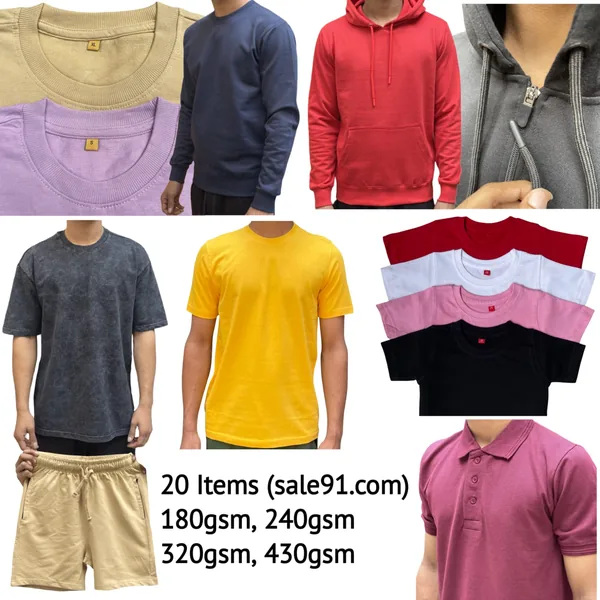
Our plain t-shirts — available in 180 GSM, 200 GSM, 210 GSM, and 220 GSM — are all 100% ring-spun combed cotton, bio-washed, and pre-shrunk. For DTF printing, the 200 GSM and 220 GSM weights are especially recommended: the denser weave provides more fibre surface area for the adhesive to grip, which translates to demonstrably more durable prints through wash cycles. The 180 GSM is excellent for everyday wear but the slightly looser weave structure means print adhesion depends even more heavily on correct press parameters.
If you are scaling a printing business and need consistent results, selecting the right GSM is as important as selecting the right film. Many printers who struggle with durability issues find that switching from a 180 GSM blank to a 200 GSM or 220 GSM blank resolves a significant portion of their edge-lifting and cracking complaints — without changing a single other variable. You can browse our full range at the BulkPlainTshirt.com product catalog.
For printers building a sustainable business, our guide on t-shirt printing business earnings and process planning covers how to systematically control variables like these to protect your margins.
How to Spot a Bad DTF Print Before You Buy — The Stretch Test
If you are purchasing printed t-shirts from a supplier — or doing quality control on your own production run before dispatch — there is one simple, tool-free test that takes under five seconds per piece.
What good looks like: The print stretches with the fabric and returns to its original appearance without any visible change. No lines, no white breaks.
What bad looks like: Fine white lines appear within the design during the stretch. These are micro-cracks in the adhesive layer that have already formed but are not yet visible at rest. This print will fail within the first few washes — do not accept or dispatch this batch.
This test works because the white lines you see during the stretch are the same cracks that will propagate and become visible at rest after wash stress. A properly bonded DTF print on a quality cotton base should stretch with the fabric elasticity and return without any visible line formation.
Additional Quality Checkpoints for DTF Prints
- Stretch test: no white lines at 20–30% lateral stretch
- Edge integrity: no lifting or peeling at design edges when cold
- Surface feel: smooth and slightly matte, not rubbery or stiff (over-cured adhesive)
- Tactile adhesion: press thumbnail firmly at design edge — should not lift
- Wash test (sample): machine wash one piece inside-out at 40°C before bulk dispatch
- Visual post-wash: no cracking, no colour fading, no edge lift after wash #1
- Visual post-wash #2: repeat after second wash — this is the real durability test
The Monsoon Factor: Why Print Failures Peak in July–August
Monsoon humidity levels in India — particularly in cities like Mumbai, Kolkata, Chennai, and even Delhi during July and August — significantly affect both the printing process and the washing environment. Here is how:
During Printing
High ambient humidity (above 70% RH) affects DTF adhesive powder behaviour. The powder can absorb atmospheric moisture before it is fully cured, which interferes with the cross-linking chemistry. In a non-climate-controlled printing space during monsoon season, even a correctly specified curing oven may not achieve the intended result if the adhesive powder has already absorbed humidity before entering the oven.
During Washing
Monsoon-season washing in India often involves higher water mineral content (particularly in cities with older pipe infrastructure), longer drying times, and sometimes repeated washing due to humid drying conditions. Each wash cycle subjects the print to approximately 30–45 minutes of agitation, heat, and chemical stress from detergents. A print with even minor adhesion deficiencies is much more likely to show cracking in monsoon conditions than in dry-weather washing.
This explains the seasonal pattern: printers who cut corners on film quality or curing often do not see failures during Rabi season orders (October–February), but face significant return rates on the same process during Kharif season (June–September). The process was always flawed — the monsoon just reveals it faster.
What This Means for Your Printing Business and Blank T-Shirt Sourcing
The cost-quality calculation in DTF printing is straightforward when you look at it honestly. The ₹15 per piece saving on cheap film, compounded across 300 pieces, is not a saving — it is a deferred liability that shows up when your customer calls after two washes. And in the printing business, word-of-mouth about quality failures travels faster than word-of-mouth about quality successes.
The two variables you fully control as a printer are: (1) the quality of your consumables (film, ink, adhesive powder) and (2) the quality of the blank t-shirt you print on. Everything else — heat press calibration, curing parameters — requires process discipline, but starts with the right materials.
On the blank t-shirt side, sourcing from a manufacturer who knits their own fabric — rather than a trader or reseller buying from multiple mills with inconsistent lot quality — gives you a predictable, uniform base for every batch. At Sale91.com, we knit our own fabric in-house at our Tiruppur facility, which means the GSM, cotton grade, bio-wash intensity, and pre-shrink percentage are consistent across every lot we ship. That consistency is directly relevant to print durability, because an inconsistently manufactured blank produces inconsistent print results even with perfect press parameters.
We currently carry 1 lakh+ pieces in ready stock at any time, with a minimum order quantity as low as 10 pieces for ready stock items. If you want to run a test batch — 10–50 pieces across multiple GSM weights to identify which base performs best with your specific DTF setup — you can do that without a large upfront commitment. If your order exceeds 500 pieces, you receive an additional ₹2 per piece discount. And for any order placed online, an additional ₹3 per piece online purchase discount applies regardless of quantity.
For new buyers, 50% COD is available on the first order (with a 3% COD charge), so you can verify quality before committing to full prepaid terms. From the second order onwards, payment moves to prepaid. Details are at Sale91.com. If you're managing high order volumes and client inquiries as your business grows, our piece on managing bulk WhatsApp inquiries without getting blocked is worth reading alongside this one.
Pre-Production Checklist: Preventing DTF Print Crack on Every Batch
The following checklist is designed for printing businesses running DTF operations in India. It can be used as a standard operating procedure before every production run, adapted to your specific film and adhesive supplier specifications.
- Film sourcing: Buy only from suppliers who provide technical spec sheets with their film. Know the release temperature range of your specific film lot.
- Film storage: Store DTF film flat, in sealed packaging, away from direct sunlight and humidity. Do not use film stored in humid conditions for more than 30 days without re-testing.
- Adhesive powder curing: Verify curing oven temperature with an external probe thermometer — do not rely on the oven's built-in display alone.
- Heat press calibration: Use a calibration thermometer on the platen surface at least once a week. Record readings. Adjust dial offset accordingly.
- Press time: Use a dedicated timer, not manual counting. Human counting under production pressure is inaccurate.
- Peel method: Know whether your film is hot-peel or cold-peel. Apply the correct method consistently. Never rush the peel step.
- Blank fabric: Use 100% ring-spun combed cotton, bio-washed, pre-shrunk base. 200 GSM or 220 GSM recommended for maximum print durability.
- Pre-press: Pre-press the blank t-shirt for 3–5 seconds before applying the DTF transfer to remove moisture and wrinkles from the print area.
- Sample wash: Always wash one sample piece before dispatching a bulk batch. Do not skip this step.
- Stretch test: Apply the stretch test to 5–10% of pieces from every production run before packing.
- Monsoon adjustment: In monsoon months (June–September), reduce ambient humidity in your workspace if possible, and increase curing time by 10–15% as a buffer.
Watch the Video
This article expands on our Factory Sach short-form video series — honest, unfiltered insights from inside the t-shirt manufacturing world. Watch the original video below:
Frequently Asked Questions
More Articles

Ready to Print on Fabric That Won't Let Your Prints Down?
Our 100% ring-spun combed cotton blanks — bio-washed, pre-shrunk, available in 180 to 220 GSM — are the canvas that makes your DTF prints last. With 1 lakh+ pieces in ready stock, MOQ from just 10 pieces, and ₹3/piece online discount on every order, your next production run starts here.
Order Plain T-Shirts at Sale91.com →