T-Shirt Printing Business Earning ₹50,000/Month — My Real 2018 Blueprint for Indian Printers
Published: July 12, 2026 | By Sale91.com | 10 min read
The Short Version: Back in 2017–18, it was possible to build a stable ₹50,000–60,000/month income from custom t-shirt printing in India — without owning a factory, without a large team, and without a fancy website. This article breaks down the exact approach, the two key supply chain relationships you need, the niche targeting strategy that actually works, and why plain t-shirt quality is the silent make-or-break factor in this business.
Why ₹50,000/Month From T-Shirt Printing Is Still Realistic in 2026
Let's be direct: the custom t-shirt printing business has only gotten easier since 2018. Printers that used to cost ₹10 lakh now start at ₹20,000–50,000. Social media targeting tools are sharper. Plain t-shirt suppliers like Sale91.com now offer MOQs as low as 10 pieces with ready stock available 24/7. If anything, the opportunity has expanded — the core blueprint has simply shifted from Facebook groups to Instagram Reels and WhatsApp communities.
But the fundamentals? Identical. You still need two things to make this work: a reliable plain t-shirt source and a reliable printing solution. Everything else — audience, niche, margins — is built on top of those two pillars.
The 2018 blueprint this article documents is not a motivational story. It is a replicable operating model with specific inputs, specific channels, and specific consistency requirements. Let's walk through it step by step.
The Two-Vendor Model: Your Entire Supply Chain in Two Relationships
The original approach was elegantly simple. Rather than building a vertical operation from scratch, it depended on two specialist vendors doing what they do best:
Vendor 1 — Plain T-Shirt Supplier
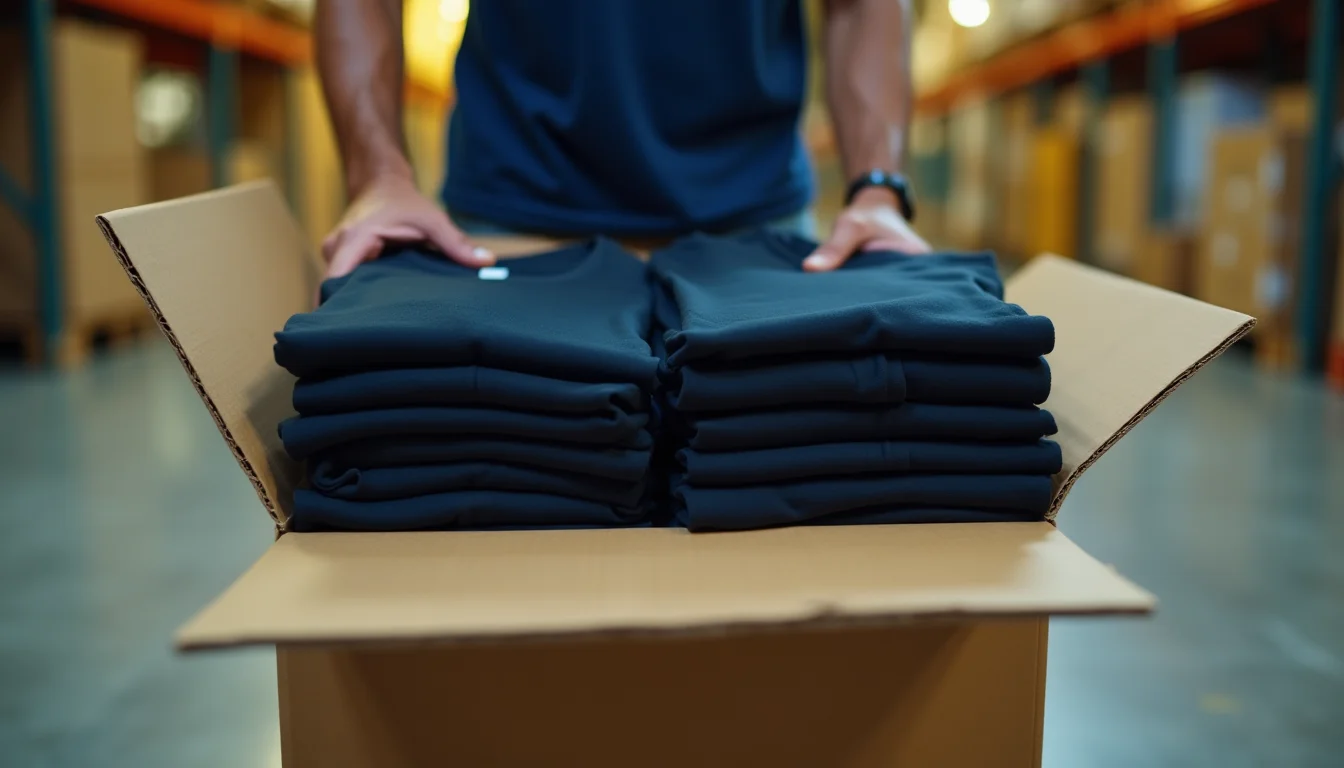
This is where your blank canvas comes from. The quality of your plain t-shirt directly determines how well the print adheres, how the final product looks on the customer, and whether you get repeat orders or refund requests. In the early days, finding a reliable plain t-shirt supplier in Tiruppur — India's textile manufacturing hub — was difficult for small buyers. Today, Sale91.com (also known as BulkPlainTshirt.com) has bridged exactly this gap: they manufacture their own fabric in-house (they are not traders or resellers), maintain 1 lakh+ pieces in ready stock at any time, and ship PAN India from their Delhi warehouse in Khanpur, South Delhi.
For a new printing business, the practical implication is significant: you can order as few as 10 pieces to test a new colour or size run, and scale to 500+ pieces once demand is established — at which point you get an additional ₹2/piece discount for bulk. There is also an COD option for first-time bulk orders which dramatically reduces the risk of testing a new supplier.
Vendor 2 — Printing Solution
Your second relationship is with whoever handles the actual printing. In 2017–18, the main method was screen printing for large runs. Today, Indian printers have far more options: DTG (Direct to Garment), DTF (Direct to Film), screen printing, and heat transfer — each suited to different order sizes and design complexities.
If you want to outsource printing without owning equipment, find a local printing vendor. If you want to own a printer, entry-level DTF printers are now available in the ₹20,000–50,000 range from reputable vendors (a Google search for "Boom Enterprise" will surface one such supplier). Owning your printer gives you faster turnaround and better margins on large orders; outsourcing keeps your capital requirements near zero at startup.
Key Insight: The two-vendor model means your job is business development and client management — not manufacturing. You sit in the middle: source blank tees, get them printed, deliver to clients. This low-overhead structure is what makes the ₹50K/month target achievable without significant capital.
Choosing the Right Plain T-Shirt for Your Printing Business: A Decision Table
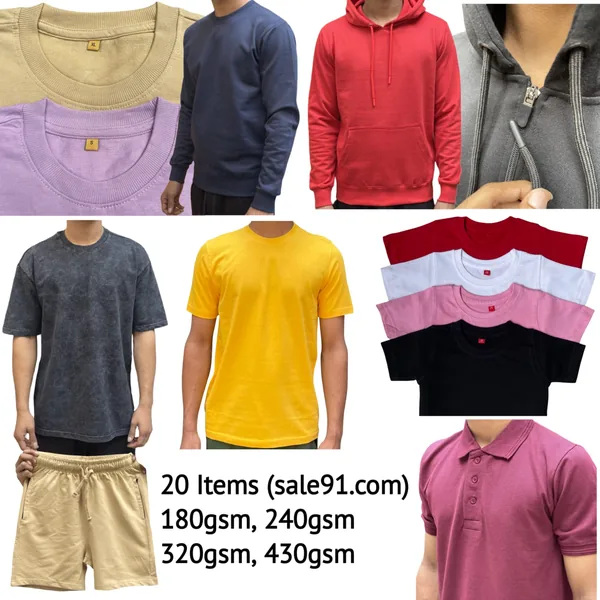
Not all blank t-shirts print the same way. GSM (Grams per Square Metre) affects print quality, ink absorption, and customer perception. The table below maps Sale91.com's real product range to common printing use cases — this is original sourcing intelligence you won't find in generic "start a t-shirt business" articles. For a quick primer on terms like bio-wash and pre-shrunk, see the BulkPlainTshirt FAQ.
| Product | GSM | Best Printing Method | Best Use Case | Notes |
|---|---|---|---|---|
| Plain Round Neck | 180 | DTF, Heat Transfer | Events, colleges, daily wear | Lightest weight; economical for large runs |
| Plain Round Neck | 200 | DTG, Screen Print, DTF | Brand merchandise, corporate | Most popular GSM for printing businesses |
| Plain Round Neck | 210 | DTG, Screen Print | Premium retail, D2C brands | Better drape; suits detailed artwork |
| Plain Round Neck | 220 | Screen Print, DTG | Heavy premium collections | Sturdier feel; commands higher retail price |
| Oversized T-Shirt | 200–220 | DTF, DTG | Youth fashion, streetwear | Oversized fit; high trend demand in 2024–26 |
| Plain Polo | 200+ | Screen Print, Embroidery | Corporate gifting, uniforms | Collar structure suits professional branding |
| Hoodie / Sweatshirt | 240–430 | DTG, Screen Print | Winter drops, premium merch | Higher ASP; ideal for high-margin runs |
| Acid Wash T-Shirt | 200+ | DTF (limited areas) | Vintage/streetwear aesthetics | Pre-treated texture; print on front chest works best |
All Sale91.com products are 100% cotton, ring-spun combed, bio-washed, and pre-shrunk — which matters enormously for printing: a shirt that has not been pre-shrunk will distort a screen-printed graphic after the first wash, leading to returns. You can browse the full product range at the BulkPlainTshirt product catalog.
The Niche Strategy: Why Targeting a Specific Community Beat Everything Else
This is the part of the 2018 blueprint that most generic business advice completely misses. In 2017–18, when the custom t-shirt market was already crowded, the differentiator was not the printing quality or even the price — it was cultural relevance.
The approach that worked was to pick a single tightly-defined community — in this case, Delhi University students — and become the de facto t-shirt supplier for that community. Here is what that looked like in practice:
Step 1 — Pick a Niche Community
Delhi University was one example. Your niche could be a local sports league, a city's startup ecosystem, a specific college, a music genre community, a regional cultural group, or a professional trade — the criteria are: (a) they have a strong shared identity, (b) they communicate on social media, and (c) they occasionally need printed t-shirts for events, fests, or merchandise.
Step 2 — Become Organically Visible in That Community
The tactic in 2018 was to actively engage on Facebook and Instagram pages related to that niche — commenting meaningfully, sharing relevant content, and creating designs that spoke to that community's specific culture. This is not paid advertising. It is consistent, manual community building. In 2026, the equivalent is showing up in relevant Instagram communities, WhatsApp groups, LinkedIn groups, or Discord servers — wherever your target niche congregates online.
Step 3 — Create Demand by Demonstrating Relevance
Share design mockups that your niche community would actually want to wear. Post content that signals you understand their culture. When someone in that community needs custom t-shirts for a college fest, a corporate team, or a fan meetup, you want to be the obvious person they think of. This credibility cannot be bought with ads — it has to be earned through consistent presence.
Step 4 — Convert Inbound Inquiries, Not Cold Leads
Once visibility is established, inquiries start coming to you. This is the fundamental business model shift: instead of pitching strangers, you are fielding warm leads from people who already know your work. Conversion rates on warm inbound leads are dramatically higher, and average order values tend to be larger because the client already trusts you.
Timeline Reality Check: The niche-building phase takes real time. Expect 10–12 days of active daily posting before you are noticed. Expect 3–4 months before the business starts generating consistent monthly income. Consistency across this full period is non-negotiable. Stopping at week 3 because "nothing has happened yet" is why most people never see results.
What Does ₹50,000–60,000/Month Actually Look Like as a Business Model?
Let's think through the unit economics clearly, framed as a hypothetical to illustrate the math.
Suppose you are sourcing 200 GSM plain t-shirts from Sale91.com. You order 500 pieces (which qualifies for the ₹2/piece bulk discount), plus you purchase online (which adds a further ₹3/piece discount). You get the printed shirts to a client community at a margin that covers printing cost plus your profit. At a modest margin per piece across 500 units monthly, the ₹50,000 target is arithmetic — not aspiration.
The key levers are:
- Blank t-shirt cost: Lower with bulk discounts (₹2/pc off at 500+, ₹3/pc off for online orders at Sale91.com)
- Printing cost: Lower if you own your DTF printer; variable if outsourced
- Sell price: Higher when you serve a niche with genuine demand (community merchandise commands a premium vs. commodity printing)
- Volume: The scale needed to hit ₹50K/month is achievable without an office or staff once the client pipeline is established
If you are scaling inquiries and find yourself handling 200+ daily WhatsApp messages from clients, it is worth knowing that there are ways to manage bulk WhatsApp inquiries without getting blocked — a real operational concern as your volume grows.
The 30-Day Launch Checklist: From Zero to First Order
Week 1 — Setup
- Order plain t-shirt samples from Sale91.com (MOQ as low as 10 pieces) — test at least 2 GSM options (e.g., 180 and 200) in your most likely colours
- Wash samples twice, check for shrinkage and colour fastness (pre-shrunk and bio-washed products should hold well — if not, this is your quality signal before committing to bulk)
- Decide: outsource printing (find a local DTF/screen printer) OR invest in an entry-level DTF printer
- Create your Instagram/Facebook business profile focused on your chosen niche
- Identify 10–15 active pages, groups, or accounts in your target niche community
Week 2–3 — Community Building
- Post 1 piece of niche-relevant content every day (design mockup, behind-the-scenes, t-shirt quality reel)
- Engage meaningfully on at least 5 posts per day in your target niche (comments, not just likes)
- DM 3–5 people per day who are organically relevant (event organizers, club heads, community managers) — not sales pitches, genuine introductions
- Share a free design concept specifically tailored to your niche — this demonstrates your understanding of their culture
- Start collecting a WhatsApp contact list of warm contacts
Week 4 — First Order Conversion
- By day 10–12, you should see inbound inquiries; respond within the hour
- Offer a small first-order trial (even 20–30 pieces) to convert the first client — proof of quality matters more than margin at this stage
- Deliver on time, document the finished product with good photos, get a testimonial
- Use that testimonial as social proof content to accelerate the next inquiry cycle
- Reinvest a portion of the first order margin into your next plain t-shirt order (scale toward 500 pieces for bulk discount eligibility)
Common Mistakes That Kill New Printing Businesses Before Month 3
Mistake 1 — Inconsistent Plain T-Shirt Quality
Switching suppliers mid-business to save ₹2/piece is one of the most common and costly decisions new printers make. Different suppliers produce different fabric weights, different colour consistency, and different pre-shrink treatments. Colour consistency is a real concern — for example, white vs. off-white colour confusion is an actual sourcing pitfall that can result in rejected batches and unhappy clients. Stick to one quality-verified supplier once you have validated their product.
Mistake 2 — Trying to Serve Everyone
The blueprint only works because of niche focus. A printing business that tries to simultaneously serve college fests, corporate offices, NGOs, and wedding planners in its first three months will produce generic marketing that resonates with no one. Pick one niche, dominate it, then expand.
Mistake 3 — Abandoning Consistency Before Results Appear
This deserves repetition because it is the single most common failure mode. Community building takes 3–4 months to generate consistent monthly income. Most people stop at week 3. The ones who reach month 4 are the ones writing income screenshots on social media.
Mistake 4 — No Referral or Repeat Order System
Once you have a happy client, that client is your best acquisition channel. If you want to explore low-effort income streams beyond direct printing, it is worth looking at models like the Sale91 referral program, which allows you to earn per-piece income simply by connecting buyers to a verified supplier.
Why the Plain T-Shirt Source Is the Silent Variable in Your Printing Business
Most custom printing business guides spend 80% of their content on design, marketing, and pricing — and approximately zero words on blank t-shirt quality. This is a significant omission, because in the custom printing value chain, the blank t-shirt is the substrate on which everything else depends.
Consider what happens downstream when you cut corners on blanks:
- A non-pre-shrunk shirt will distort the print after the first wash — client returns, reprint cost, reputation damage
- A non-bio-washed shirt has a rougher hand feel — your client notices, and so does their customer
- Inconsistent GSM across a batch means some shirts look heavier/lighter than others in the same order — a quality problem that is impossible to explain to a client who ordered "one consistent product"
- Poor ring-spun quality means pilling and texture degradation after a few washes — the t-shirt stops looking good, and the printing takes the blame
This is why the 2018 blueprint specifically emphasised "ek achha PLAIN T-SHIRT wala banda" — a good plain t-shirt person, not just a cheap one. BulkPlainTshirt.com (Sale91.com) knits their own fabric in Tiruppur rather than buying from yarn traders, which gives them direct control over cotton grade, GSM consistency, and finishing quality. With 1,25,232+ pieces shipped in just the last 30 days, the throughput volume is itself a signal of operational reliability.
Watch the Original Video
The blueprint above was originally shared as a YouTube Short. Watch the full original video below for the unfiltered, first-person account:

Frequently Asked Questions
Ready to Start Your T-Shirt Printing Business?
Order plain t-shirt samples from India's own-fabric manufacturer. MOQ from 10 pieces. 15+ colours. 180–220 GSM options. 1 lakh+ pieces in ready stock. Delhi warehouse. PAN India shipping.
Order Samples at Sale91.com →