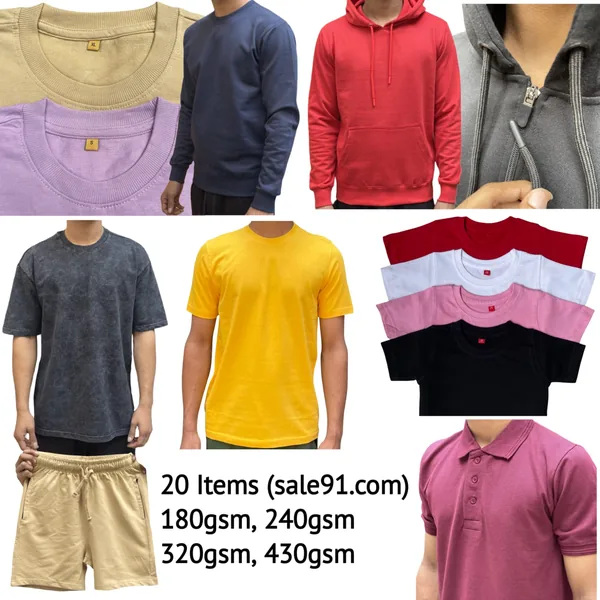
Premium Plain T-Shirt Bulk Supplier India — Own Yarn, Own Knit Fabric, GSM 180 to 430 Explained

Walk into any wholesale garment market in Tiruppur, Surat, or Delhi's Gandhi Nagar and you will find hundreds of vendors claiming to offer "premium quality plain t-shirts." But ask them a simple question — "Do you knit your own fabric?" — and most will go quiet. The hard truth is that the majority of plain t-shirt suppliers in India are traders: they buy grey fabric from third-party knitting units, get it dyed, and stitch it up. The result? Inconsistent GSM, unpredictable shrinkage, variable colour batches, and — for printing businesses — ruined jobs.
Sale91.com (operating as BulkPlainTshirt.com) is built on a fundamentally different model. Under the tagline "Own Knitted Blank Wears," we spin our own yarn and knit our own fabric in-house, entirely in Tiruppur — India's undisputed textile capital. This single vertical-integration decision changes everything: from the feel of the fabric on your customer's skin to the accuracy of ink adhesion on a DTF print, from the GSM you ordered matching the GSM you received, to the colour consistency across 5,000-piece repeat orders.
This article is a deep-dive into that story. We will explain what vertical integration actually means in a textile context, decode every GSM grade we offer (180 / 200 / 210 / 220 / 240 / 320 / 430), walk through our yarn and knit quality-control process, clarify what true bio-wash means (versus the lip-service version), and finally lay out a step-by-step sourcing journey — from ordering samples to placing your first bulk order — designed specifically for DTG/DTF printers, screen printers, heat-transfer businesses, resellers, and dropshippers across India.
What "Vertically Integrated" Really Means for a T-Shirt Manufacturer
In the garment supply chain, vertical integration means owning and controlling more stages of production under one roof. For a plain t-shirt manufacturer, the full chain looks like this:
- Raw Cotton → Yarn Spinning: Cotton fibres are combed, drawn, and twisted into yarn.
- Yarn → Knitted Fabric: The yarn is fed into circular knitting machines to create jersey or interlock fabric.
- Grey Fabric → Dyeing & Finishing: Fabric is scoured, dyed in the required colours, bio-washed, and pre-shrunk.
- Finished Fabric → Cutting & Stitching: Panels are cut to pattern and assembled into garments.
- Finished Garment → QC & Dispatch: Each piece is checked and packed for B2B shipment.
Most Indian plain t-shirt suppliers enter this chain only at Stage 4 — they buy dyed fabric (or even ready-cut panels) from external suppliers. This means they have no visibility or control over the GSM accuracy of the fabric, the yarn count used, or the consistency of the finishing process. Every batch they buy could come from a different knitting unit with different machinery and different yarn suppliers.
BulkPlainTshirt.com controls the process from Stage 1 to Stage 5. We spin our own combed ring-spun cotton yarn, knit it on our own circular knitting machines calibrated to exact GSM targets, and run the fabric through our own dyeing and bio-wash units. By the time a t-shirt leaves our warehouse in Khanpur, South Delhi, every specification — GSM, colour, shrinkage, hand-feel — has been verified at multiple checkpoints that we own.
Yarn Quality: The Foundation Everything Else Is Built On
Combed vs. Carded Cotton — Why It Matters for Printing
Not all cotton yarn is equal. Carded yarn is produced by quickly aligning cotton fibres using a carding machine. It leaves short, broken fibres in the yarn, resulting in a slightly rough, "fuzzy" surface on the finished fabric. Combed yarn takes an extra step — the fibres are combed again to remove all short fibres and align the long, uniform fibres in parallel. The result is a smoother, stronger, more uniform yarn.
For blank t-shirts used in printing — especially DTG (Direct to Garment) and DTF (Direct to Film) — surface smoothness is not a cosmetic preference; it is a technical requirement. A fuzzy carded fabric absorbs pre-treatment chemicals unevenly and creates micro-gaps in ink adhesion. On a combed ring-spun fabric, the ink sits on a consistent, tight surface, producing sharper edges, more vibrant colours, and better wash durability.
All BulkPlainTshirt.com products — across every GSM grade — use 100% combed ring-spun cotton. Ring spinning produces a tighter, more uniform yarn twist compared to open-end (rotor) spinning, further improving strength and surface quality. This is not an upgrade option; it is our standard. If you have ever experienced fabric quality losses in a bulk order, the yarn type is often the root cause nobody warned you about.
Yarn Count and GSM — The Technical Relationship
Yarn "count" (measured in Ne — English cotton count) determines how fine or coarse the yarn is. A higher Ne number means finer yarn. The GSM (grams per square metre) of the finished fabric depends on the yarn count used and the stitch density settings on the knitting machine. Because we control both variables in-house, we can hit a precise GSM target consistently across every production run. Traders buying grey fabric from external units have no such guarantee — their 200 GSM order in April might arrive at 192 GSM in August because the knitting unit swapped yarn suppliers.
GSM Grades Explained: Which One Is Right for Your Business?
GSM is arguably the single most important specification a printing business or reseller needs to understand before placing a bulk t-shirt order. Here is a complete breakdown of every GSM grade we manufacture and the applications each is best suited for:
| GSM | Product Type | Hand Feel | Best For |
|---|---|---|---|
| 180 | Plain Round Neck T-Shirt | Light, breathable | Summer wear, casual everyday, screen print, heat transfer |
| 200 | Plain Round Neck T-Shirt | Medium-weight, balanced drape | Brand merchandise, DTG printing, retail-grade reselling |
| 210 | Plain Round Neck T-Shirt | Slightly heavier than 200 | Premium casual, year-round wear, DTF printing |
| 220 | Plain Round Neck / Oversized T-Shirt | Heavy, structured feel | Oversized streetwear, embroidery, premium retail |
| 240 | Plain Polo T-Shirt / Light Sweatshirt | Dense, substantial | Corporate uniforms, polo shirts, light outerwear |
| 320 | Plain Hoodies & Sweatshirts | Thick, warm, mid-weight fleece | Winter merchandise, college drops, brand hoodies |
| 430 | Premium Hoodies & Sweatshirts | Extra-thick, luxury weight | High-end streetwear brands, cold-climate markets |
The 180 GSM Debate: Is It Too Light for Printing?
One of the most common questions from new printing businesses is whether 180 GSM is "too thin" for print work. The short answer: it depends on the print method. For screen printing and heat transfer vinyl (HTV), 180 GSM from a combed ring-spun base is perfectly adequate — the fabric is smooth, pre-shrunk, and the print sits well. However, for embroidery work, 180 GSM can create puckering under the needle tension — and this is a real-world problem that has cost embroidery businesses hundreds of t-shirts in wasted stock. If embroidery is your primary decoration method, we recommend starting at 200 GSM minimum, ideally 220 GSM for structured designs.
220 GSM for Oversized T-Shirts — The Streetwear Sweet Spot
The oversized t-shirt category has exploded in India over the last three years, driven by streetwear culture and social-media-first D2C brands. For oversized silhouettes, weight matters more than in standard fits because the extra fabric needs to drape correctly — too light and it looks cheap, too heavy and it restricts movement. Our 220 GSM oversized t-shirts hit the sweet spot that Tiruppur's experienced cutters have refined over decades. The structured body holds screen-print graphics beautifully, while the bio-wash treatment gives it a premium garment-washed look straight out of the pack.
Our Knit Quality Control Process: What Happens Between Yarn and Finished Fabric
In-house knitting gives us quality checkpoints that no trader-supplier can offer. Here is what happens before a single metre of fabric is approved for cutting:
1. Yarn Lot Inspection
Every yarn lot received at our Tiruppur unit is inspected for count consistency, moisture content, and tensile strength before it enters the knitting machines. Lots that fall outside tolerance are rejected at this stage — not after the fabric is already knitted and dyed.
2. Knitting Machine Calibration
Our circular knitting machines are calibrated for each GSM target. Stitch density (courses per cm and wales per cm) is set and locked. The first 5 metres off each machine run are GSM-tested using a precision weighing die before full production begins. If the GSM deviates by more than ±3 grams, the machine settings are re-adjusted.
3. Grey Fabric GSM Audit
After knitting, grey fabric rolls are tested again. We use a 100 cm² die-punch GSM tester — the same standard used by major international apparel buyers. This audit happens before dyeing, because dyeing itself causes a minor GSM change (typically +2 to +5 GSM due to dye uptake and finishing chemicals). Our knitting targets are calibrated to account for this change so the finished, dyed fabric hits the stated GSM.
4. Post-Dyeing GSM Verification
After dyeing and bio-wash finishing, fabric rolls are tested one final time. This is the GSM figure that matches what you see listed on Sale91.com product pages. When you order 200 GSM, the fabric that goes into your t-shirt has been verified at 200 GSM (±3 tolerance) after all finishing processes.
True Bio-Wash: What It Is and Why Most Suppliers Get It Wrong
"Bio-washed" has become a marketing term that many suppliers use without actually performing the process correctly. Let us be precise about what true bio-wash means and what it does for your t-shirts.
The Enzyme Treatment Process
Bio-wash (also called enzyme washing) involves treating the finished fabric with cellulase enzymes — naturally occurring proteins that gently break down the surface fibres of cotton without damaging the core yarn structure. The result is a fabric that feels immediately soft when you first touch it, rather than a stiff, scratchy feel that only softens after several home washes.
The "wrong way" many suppliers do it: a weak enzyme soak followed by an inadequate rinse, resulting in residual enzyme activity in the fabric. This continues to slowly degrade the fabric fibres during storage and use, leading to premature fabric thinning and pilling after 10-15 washes — a defect that appears long after the buyer has paid and the complaint window has closed.
Our bio-wash process uses a calibrated enzyme concentration, controlled pH (4.5 to 5.5), controlled temperature (55°C), and a timed neutralisation rinse that terminates enzyme activity completely. The result is a permanently softened fabric surface with zero residual enzyme degradation risk. Combined with our pre-shrunk finishing (mechanical compaction on a compactor machine), our t-shirts maintain dimensional stability — meaning the size you print on is the size your customer wears, even after 30 washes.
The Samples-Then-Bulk Sourcing Process: A Practical Roadmap
Whether you are a DTG printer in Bangalore scaling up your blank inventory, a screen-printing house in Mumbai looking for a consistent 500-piece monthly supplier, or a dropshipping reseller building your first private-label t-shirt brand — the sourcing journey should always follow the same disciplined sequence. Here is the process we recommend, and the one we are built to support:
Step 1: Define Your GSM and Print Method
Before you request samples, clarify what you need. What decoration method are you using — DTG, DTF, screen print, embroidery, heat transfer? What target price point is your finished product? Summer or year-round? These decisions determine your GSM (refer to the table above). Confusing 180 GSM and 220 GSM at the sourcing stage is the kind of mistake that leads to bulk orders going wrong without samples — a costly lesson we see repeatedly in the industry.
Step 2: Order a Sample Set from the Catalog
Our MOQ for ready-stock items starts at just 10 pieces. Browse the full product catalog at BulkPlainTshirt.com/catalog and order samples in your target GSM, 2-3 colours you plan to use most, and the sizes most relevant to your market. When your samples arrive, test them for:
- Hand-feel and surface smoothness (run your palm across the front panel)
- Actual weight (use a kitchen scale and a 100 cm² cut to verify GSM)
- Shrinkage (wash at 40°C three times, then measure against original dimensions)
- Colorfastness (rub a damp white cloth firmly — colour transfer should be minimal)
- Print adhesion (run your print process on 2-3 sample pieces before committing to bulk)
Step 3: Run Your Print Tests
Never place a bulk blank order based on fabric feel alone. Always test your actual print process on samples. DTG printers: run a full white ink under-base test. Screen printers: test plastisol ink adhesion and flash cure timing. Heat transfer businesses: test peel temperature and adhesion on all target colours, especially darker shades. Colorfastness under repeated washing is a separate test — and skipping it has caused disasters for growing print businesses.
Step 4: Place Your First Bulk Order with 50% COD
First-time buyers on Sale91.com can place their first order with 50% COD (Cash on Delivery) — pay the remaining 50% on delivery. A 3% COD processing charge applies. This option is specifically designed to reduce the risk for new buyers who haven't yet built trust with a new supplier. From the second order onwards, payment moves to full prepaid (with faster processing).
Step 5: Lock In Your Pricing Tier
For orders of 500 pieces or more, you qualify for an automatic Rs 2/pc discount. Additionally, all online purchases through Sale91.com carry a Rs 3/pc online purchase discount regardless of quantity. These discounts stack for large orders, making our pricing highly competitive even against grey-market fabric traders — with the added security of a verified manufacturer.
Who We Sell To: B2B Buyers Across India and Beyond
Custom Printing Businesses
DTG, DTF, screen print, and heat transfer printing businesses are our primary customer base. Blank t-shirt quality directly determines your print output quality and your return/rejection rate. Our consistent GSM, pre-shrunk dimensions, and bio-washed surface make us the preferred blank supplier for serious printing operations across Tiruppur, Delhi, Mumbai, Bangalore, Hyderabad, and beyond.
Wholesalers and Resellers
If you are building a private-label plain t-shirt brand or running a wholesale operation for local retailers, our ready stock of 1 lakh+ pieces at any time ensures you never face a stockout on your best-selling colours and sizes. We ship PAN India via courier with 1-2 day delivery to Delhi-NCR from our Khanpur warehouse and 2-5 day delivery to most other major cities.
Dropshippers
Our low MOQ of 10 pieces and online ordering through Sale91.com makes us accessible to dropshipping businesses that need reliable quality at scale without holding large inventory. As your order volumes grow, our pricing tiers reward you automatically.
Export Buyers
We export to international buyers via courier (DHL, FedEx) for smaller consignments and via sea container for bulk orders. Our Tiruppur manufacturing base gives international buyers the confidence of dealing directly with a knitting and manufacturing unit — not a middleman.
Available Colors, Products, and Ready Stock
Our plain t-shirt range is available in 15+ colours including white, black, navy, grey, maroon, olive, royal blue, sky blue, red, yellow, pink, orange, and seasonal fashion shades. All colours undergo our full bio-wash and pre-shrunk process and are colorfastness-tested before dispatch.
Current product range available for bulk ordering:
- Plain Round Neck T-Shirts — 180, 200, 210, 220 GSM
- Oversized T-Shirts — 220 GSM
- Plain Polo T-Shirts
- Plain Hoodies & Sweatshirts — 240, 320, 430 GSM
- Acid Wash T-Shirts — Regular and Oversized
With over 1,25,232 pieces sold in the last 30 days and a standing ready stock of 1 lakh+ pieces, we have the depth to fulfil large, time-sensitive orders without lead-time surprises. View the full catalog and current stock availability at BulkPlainTshirt.com/catalog.
See Our Manufacturing Process
Watch how we knit our own fabric and maintain quality at every step — from yarn to finished plain t-shirt:
Frequently Asked Questions
More Articles



Ready to Source Blanks You Can Actually Trust?
Over 1,25,000 pieces shipped last month. 1 lakh+ pieces in ready stock. GSM-verified, bio-washed, combed ring-spun cotton — manufactured entirely in Tiruppur. Order samples today from as low as 10 pieces, or place your bulk order online and get Rs 3/pc off instantly.
Order on Sale91.com →