Rib Knit vs Single Jersey Neckline — Why T-Shirt Collar Stretches More (Knit Structure Explained)
You pull a t-shirt over your head dozens of times without thinking about it. The collar stretches wide, your head passes through, and the neckline springs back to its original shape. But here is the thing — that stretch is not an accident, and it is not simply because the collar fabric is thinner or lighter. It is the result of a deliberate structural choice: rib knit instead of single jersey.
If you run a custom printing business — DTG, DTF, screen print, or heat transfer — understanding the difference between these two knit structures matters beyond just aesthetics. It affects how your finished garments feel in a customer's hand, how they photograph for your catalog, and critically, how they hold up after repeated washing. This guide breaks down the science behind the accordion-like behaviour of rib knit necklines, what it means for collar quality evaluation, and what to look for when sourcing blank t-shirts in bulk.
Note: If you're new to terms like GSM, bio-wash, or ring-spun cotton, our FAQ page covers the basics — we'll move straight to rib knit specifics here.
What Is Single Jersey Knit? (The Body Fabric)
Before we can understand rib knit, we need to understand what single jersey is — because it forms the body of almost every plain t-shirt you will source for your printing business.
Single jersey is a weft-knit fabric made on a single bed of needles. Each stitch loop interlocks with the one above and below it in a single direction, creating a fabric where:
- The face (front side) shows smooth, V-shaped loops — this is the print surface
- The back side shows horizontal bumps (purl loops)
- The fabric has good stretch in the width (horizontal) direction
- Lengthwise stretch is more limited
- The edges tend to curl inward when cut (which is why hems must be sewn)
Single jersey at 180 GSM gives you a lightweight everyday blank. At 200–220 GSM, the same structure becomes a premium-feel blank that's heavier to the hand and better for high-opacity DTG prints. The structure doesn't change — only the yarn thickness and loop density do.
The key limitation of single jersey for a neckline: it does not have enough widthwise extensibility to safely stretch over an adult's head and then recover. If you tried to sew a neckband using the same single jersey body fabric, either the neck opening would need to be impossibly large to fit over the head, or the collar would tear under stress with repeated wear.
What Is Rib Knit? The Accordion Structure Explained
Rib knit is made on a double-bed knitting machine — one set of needles faces front, the other faces back. These two beds alternate, creating a fabric where face loops (knit stitches) and back loops (purl stitches) alternate column by column across the width of the fabric.
Each vertical column of stitches is called a wale. In rib knit, you get alternating face wales and back wales — a 1×1 rib has one face wale, then one back wale, repeating across the full width. A 2×1 rib has two face wales, then one back wale. A 2×2 rib has two face, two back, and so on.
Why Does This Create the Accordion Effect?
Imagine a traditional paper accordion (the musical instrument, or a folded map). At rest, the folds are compressed together. When you pull the accordion sideways, the folds open outward — and the overall width can expand to two or three times its resting width.
Rib knit behaves identically. At rest, the back wales tuck behind the face wales, so the fabric looks narrower than it actually is. When you apply widthwise tension — like pulling a neckline over your head — the back wales unfold outward. The fabric can expand dramatically in the widthwise direction, far beyond what single jersey is capable of, and then springs back once the tension is released.
"When you pull rib sideways, it opens like an accordion. That's why your head passes through the neck easily." — Sale91.com Textile Knowledge Series
This is not a property of the yarn or the GSM — it is a property of the knit structure itself. You could make a rib fabric from the same ring-spun combed cotton yarn as a single jersey body, at the same count, and the rib version would still stretch more widthwise, purely because of the alternating wale arrangement.
Rib Knit vs Single Jersey: A Direct Comparison Table
For printing businesses evaluating blank t-shirts, here is a structured comparison built from real knit manufacturing parameters — not generalised marketing language:
| Property | Single Jersey (Body Fabric) | Rib Knit (Collar/Cuff Fabric) |
|---|---|---|
| Needle Bed | Single bed | Double bed |
| Wale Structure | All face loops on one side | Alternating face and back wales |
| Widthwise Stretch | Moderate (30–50% typical) | High (80–150%+ depending on rib type) |
| Lengthwise Stretch | Limited | Limited |
| At-Rest Appearance | Flat, smooth face | Ribbed texture, compressed width |
| Edge Behaviour | Curls inward when cut | Stable, does not curl |
| Primary Use | T-shirt body, sleeves | Neckband, cuffs, waistbands |
| Print Suitability | Excellent (smooth, flat surface) | Poor (textured surface, not used for printing) |
| Wash Recovery | Depends on bio-wash + pre-shrunk treatment | Depends on yarn quality + knit tension — NOT guaranteed by structure alone |
One important nuance for sourcing decisions: when evaluating fabric composition choices for your blanks, the collar rib deserves its own evaluation independent of the body fabric. Some suppliers source body fabric and collar rib from different mills, which can create inconsistencies in shrinkage behaviour after washing.
Where Rib Knit Is Used on a T-Shirt — And Why
The rib neckband is the most visible application, but rib knit appears in other functional locations on a t-shirt as well:
1. Neckband (Collar)
The primary use. The neckline opening must be small enough to look clean and structured at rest, but must stretch wide enough to pass over an adult head (typically 55–62 cm circumference) without strain. Rib knit makes this possible. On our plain round neck t-shirts — available in 180, 200, 210, and 220 GSM — the collar rib is cut and sewn separately before being attached to the body, which is why you'll notice a distinct seam at the base of the collar.
2. Cuffs on Polo T-Shirts
On our plain polo t-shirts, the sleeve cuffs are also rib-knitted. The cuff must stretch open enough for a hand to slide through, then recover to hug the wrist. Single jersey would either stay loose and shapeless or require elastic insertion — rib knit achieves the same effect purely through structure.
3. Waistbands on Hoodies and Sweatshirts
On hoodies and sweatshirts (which we manufacture in 240, 320, and 430 GSM), the bottom waistband and cuffs are typically 1×1 or 2×2 rib. The heavier the sweatshirt, the heavier the rib GSM needs to be to maintain structural proportion. A 430 GSM premium heavyweight hoodie with a thin, flimsy rib waistband looks and feels incongruent — this is a quality signal worth checking when evaluating samples.
The Common Mistake: Confusing Stretch With Recovery
Here is where many printing businesses make a sourcing error that only shows up after washing. Stretch and recovery are not the same property.
Rib knit will stretch — that is guaranteed by its accordion structure. But whether it returns to its original dimensions after 20 or 30 wash cycles is determined by:
- Yarn quality — ring-spun combed cotton holds its structure better than carded or open-end spun yarn
- Knit tension during manufacture — too loose and the rib loses shape; too tight and it loses stretch
- Finishing treatment — bio-washing (enzyme treatment) stabilises the cotton fibres and reduces the likelihood of the collar losing shape in initial washes
- Pre-shrunk treatment — if the rib has not been pre-shrunk, it will shrink independently of the body fabric, causing the collar to tighten uncomfortably or pucker at the seam
This is also why fabric composition matters at the collar level. Some manufacturers use a different cotton-polyester blend for the collar rib to improve recovery — but this introduces a colour-matching problem (blended collars dye slightly differently than 100% cotton bodies). If you are sourcing for custom printing where colour accuracy matters, always confirm that the collar rib is the same 100% cotton specification as the body. Similarly, if you are curious about how yarn structure affects fabric texture, the principles carry over — structural choices at the knitting stage have downstream effects on both appearance and durability.
Evaluating Collar Rib Quality: A Step-by-Step Checklist
This checklist is specific to collar rib evaluation — you will not find this framing in a generic GSM guide. Use it when assessing any sample order of blank t-shirts for your printing business:
Rib Collar Quality Checklist (Before Bulk Order)
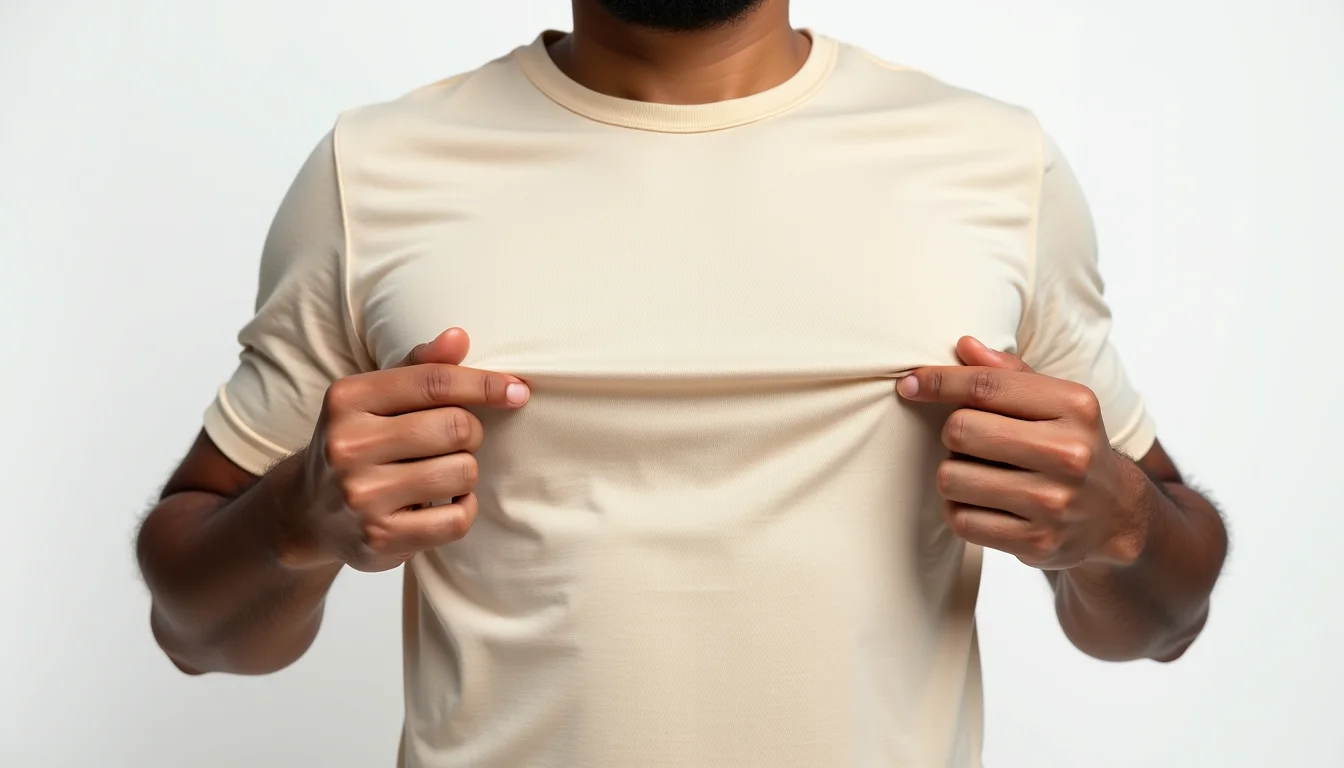
- Stretch test (dry): Pull the collar opening to its maximum width. It should reach at least 1.5× its resting circumference without effort.
- Recovery test (dry): Release the collar immediately after stretching. It should return to within 5–10% of its original shape within 3 seconds.
- Visual rib uniformity: Look at the collar under direct light. Rib wales should be even and consistent — no pulled or dropped stitches, no visible gaps.
- Seam alignment: The collar attachment seam should be flat and consistent around the full circumference — puckering indicates tension inconsistency.
- Machine wash (cold, 30°C): Wash 3–5 times. Check that the collar opening does not shrink or tighten relative to the body fabric.
- Post-wash recovery: After washing and air drying, stretch the collar again. Recovery should be comparable to the pre-wash test — if it has become permanently loose or distorted, the rib knit tension was off.
- Colour matching: After washing, compare the collar and body colour in natural daylight. They should match — divergence suggests different fibre compositions.
- Fold line check: Fold the collar in half. The two halves should sit flat against each other evenly — irregular folding indicates uneven knit tension.
Why Tiruppur Manufacturing Matters for Rib Quality
Not all rib knit is manufactured to the same standard. The quality of the double-bed knitting machine, the calibration of needle bed tension, and the finishing process all vary significantly between manufacturers.
At BulkPlainTshirt.com, our manufacturing is based in Tiruppur — India's primary textile manufacturing hub, where the density of specialised knitting machinery, skilled operators, and finishing infrastructure is unmatched domestically. We knit our own fabric in-house, which means the rib used on our collars is produced under the same quality oversight as the body single jersey — not sourced externally from a different mill.
This matters for two practical reasons. First, consistency: when the collar rib and body fabric come from the same manufacturing environment, they are finished and pre-shrunk in coordinated batches, reducing the risk of differential shrinkage at the collar seam. Second, traceability: if a collar issue emerges in your sample evaluation, we can identify exactly which production parameter needs adjustment — something that's impossible when collar and body sourcing are from different vendors.
Our Delhi warehouse in Khanpur, South Delhi, maintains 1 lakh+ pieces in ready stock at any given time — meaning sample orders can typically be fulfilled from existing stock rather than requiring a new production run, so your collar evaluation can happen on actual production pieces, not pre-production prototypes.
Rib GSM vs Body GSM — They Are Not Measured the Same Way
A common point of confusion in wholesale t-shirt sourcing: when a manufacturer states the GSM of a t-shirt (say, 220 GSM), that refers to the body fabric — the single jersey used for the main panels and sleeves. The collar rib has its own GSM, which is typically higher than the body GSM on a per-area basis because rib knit has a denser loop structure at rest.
However, rib GSM is not commonly quoted in product listings, because it is not a consumer-facing specification. What matters functionally is that the collar rib is proportionate in weight and recovery to the body fabric. A heavier 220 GSM body should have a correspondingly substantial rib — a thin, lightweight rib on a heavy body feels structurally mismatched and tends to lose shape faster.
When you view our full product catalog, the GSM specifications listed (180, 200, 210, 220 GSM for round neck t-shirts) refer to the body fabric. For collar rib specifics on any product, request a sample or contact us directly — this level of detail is relevant for professional bulk buyers and we're set up to answer it.
Practical Implications for Printing Businesses
Understanding rib knit structure has direct, practical implications for how you run your custom printing operation:
1. Collar Placement for DTG and Heat Transfer
Because rib knit has a textured, ridged surface, it is not suitable for printing. All printing must be done on the single jersey body fabric — which is why platen placement on a DTG machine always positions the garment so the collar is away from the printable area. If your platens are sized incorrectly and the collar rib is being pressed during heat transfer, you will get uneven adhesion at the collar edge.
2. Sample Evaluation Before Bulk Orders
As noted in the checklist above, always wash your sample before committing to large quantities. Suppose you order 500 pieces for a corporate uniform run — if the collar starts to droop or pucker after two washes, those 500 pieces become unsellable returns. The cost of evaluating 3–5 sample pieces through a wash cycle before ordering is negligible compared to that risk.
3. Color Consistency Across Reorders
When reordering the same t-shirt color across multiple batches, confirm that the collar rib dye lot is matched to the body fabric dye lot. In a 15+ color range like ours, subtle dye lot variation can create visible collar-to-body color differences — colour perception issues in bulk orders are more common than most buyers expect, and the collar is often the first place they appear due to its higher visual prominence.
Ordering Blank T-Shirts With Quality Collar Rib From Sale91.com
If you are sourcing blank t-shirts for a custom printing business and collar quality is part of your evaluation criteria — which it should be — here is how our ordering structure works at Sale91.com:
- MOQ as low as 10 pieces for ready stock items — low enough to evaluate collar quality before committing to bulk
- Rs 3/pc discount for online purchases at any quantity
- Rs 2/pc additional discount for orders of 500+ pieces
- 50% COD available on first orders for new buyers (+ 3% COD charge) — from second order, prepaid
- We ship PAN India and export internationally via courier and sea transport
- Over 1,25,232 pieces shipped in the last 30 days — production scale that supports consistent quality across batches
For printing businesses evaluating our collars specifically, we recommend ordering 2–3 sizes in your target color from Sale91.com as samples, washing them 3–5 times, and then applying the checklist above before placing your bulk order. This is the approach professional buyers use, and it is the approach we encourage.
Watch the Video
The short video below demonstrates the accordion structure of rib knit visually — seeing the fabric stretch and compress makes the concept significantly clearer than text alone: