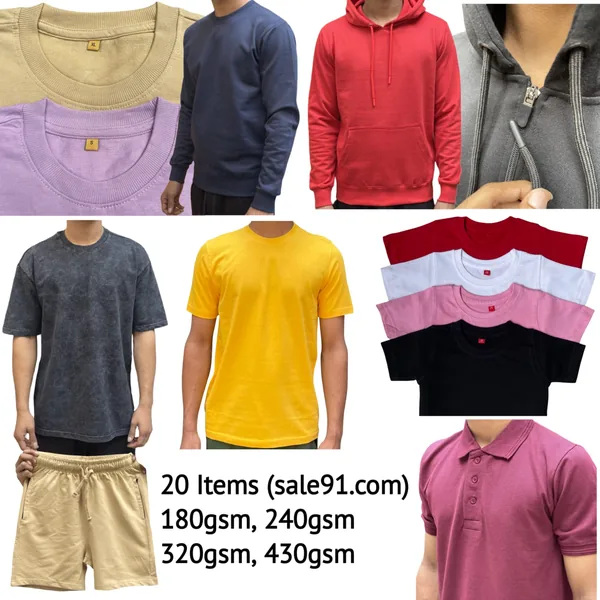
260 GSM vs 240 GSM Plain T-Shirt Wholesale — Is ₹15 Extra Per Piece Worth It for Bulk Printers?

We are launching a new 260 GSM heavyweight plain t-shirt — and the very first thing we want you to know is this: it costs ₹15–20 more per piece than our existing 240 GSM. No fine print, no hidden charge revealed at checkout. You are reading the straight numbers right here, right now.
This article explains exactly what you get for that extra ₹15–20, which type of printing business benefits most, and how to decide whether to upgrade — with a concrete spec-and-decision table built from our real product range that you will not find anywhere else. If you are already familiar with what GSM means and why bio-wash matters, skip straight to the comparison — we have linked the basics in our plain t-shirt FAQ so this article does not repeat ground already covered.
Why Launch a 260 GSM When 240 GSM Already Exists?
The honest answer is buyer feedback. We sell over 1,25,000 pieces every 30 days across India and to export customers. A consistent segment of those buyers — particularly custom apparel brands doing premium printing work under their own label — kept asking for a blank that sits noticeably above 240 GSM in hand-feel but does not cross into full sweatshirt territory.
240 GSM is already a solid premium weight. But "solid" and "heavyweight statement piece" are different positioning. Think of the difference between a good everyday premium tee and the kind of oversized drop-shoulder blank that commands a higher retail price because customers can feel the substance when they pick it up. The 260 GSM is built for that second category.
The GSM Ladder We Now Offer
To place 260 GSM in context, here is our full current weight ladder for t-shirts and tops (hoodies are separate):
| GSM | Category | Positioning | Typical Use Case |
|---|---|---|---|
| 180 GSM | Round Neck T-Shirt | Everyday / Entry | Corporate giveaways, high-volume event tees |
| 200 GSM | Round Neck T-Shirt | Premium | Retail brands, DTG printing, uniform programs |
| 210 GSM | Round Neck T-Shirt | Premium | Mid-tier retail, screen-print runs |
| 220 GSM | Round Neck T-Shirt | Heavy Premium | D2C apparel brands, export orders |
| 240 GSM | Round Neck / Oversized | Heavyweight | Premium custom brands, oversized streetwear |
| 260 GSM ✦ NEW | Round Neck / Oversized | Heavyweight+ | Premium label drops, export-quality blanks |
| 240–430 GSM | Hoodies / Sweatshirts | Winter / Fleece | Hoodie brands, custom fleece printing |
The gap between 240 GSM and 260 GSM is 20 grams per square metre. That translates to a fabric that drapes more structurally, has less see-through risk, and holds its shape more firmly after repeated washes — all factors that matter when someone is spending money on a quality print and selling it at a premium retail price.
The Honest Price Difference: ₹15–20 Per Piece — What Does It Actually Cost at Scale?
We are stating the price difference upfront because bulk printers make decisions on margin math, not on fabric romance. So let us do the math plainly.
Suppose you order 500 pieces at the 260 GSM price point vs the 240 GSM price. At ₹15 extra per piece, the total additional spend is ₹7,500. At ₹20 extra, it is ₹10,000. Now consider that on a 500-piece order you already qualify for our ₹2/piece bulk discount from Sale91.com, which partially offsets the gap. And if you place the order online, there is an additional ₹3/piece online purchase discount on any quantity.
| Order Qty | Extra Cost at ₹15/pc | Extra Cost at ₹20/pc | Online Discount Offset (₹3/pc) | Bulk Discount Offset (₹2/pc, 500+) |
|---|---|---|---|---|
| 100 pcs | ₹1,500 | ₹2,000 | ₹300 | — |
| 300 pcs | ₹4,500 | ₹6,000 | ₹900 | — |
| 500 pcs | ₹7,500 | ₹10,000 | ₹1,500 | ₹1,000 |
| 1,000 pcs | ₹15,000 | ₹20,000 | ₹3,000 | ₹2,000 |
The real question is not "can I afford the extra ₹15?" — it is "can I price my end product ₹30–60 higher per unit because the fabric genuinely justifies it?" If you are selling printed tees at ₹500–600 retail, moving to a 260 GSM blank and repricing at ₹550–650 is a legitimate product upgrade. If you are running high-volume, low-margin event tees at ₹150–180, the 240 GSM or even 220 GSM remains the right call.
"Mota fabric, better finishing — seedha hisaab, koi chupi baat nahi." That is our exact philosophy: you know the cost difference before you place a single piece.
260 GSM vs 240 GSM — Direct Spec Comparison
Both weights share the same core DNA: 100% combed ring-spun cotton, bio-washed, pre-shrunk, manufactured in Tiruppur from fabric we knit ourselves. The differences are in the numbers that matter to printers.
| Specification | 240 GSM | 260 GSM (NEW) |
|---|---|---|
| Fabric Weight | 240 g/m² | 260 g/m² |
| Yarn Type | Ring-spun Combed Cotton | Ring-spun Combed Cotton |
| Fibre | 100% Cotton | 100% Cotton |
| Bio-wash | ✓ Yes | ✓ Yes |
| Pre-shrunk | ✓ Yes | ✓ Yes |
| Hand Feel | Smooth, substantial | Noticeably heavier, more structured |
| Drape | Soft drape | More structured/body |
| Print Surface | Excellent for DTG/DTF/Screen | Excellent for DTG/DTF/Screen |
| Colors Available | 15+ colors | 2 colors at launch (expanding) |
| Price Premium vs 240 GSM | Base | +₹15–20/piece |
| Manufacturing | Tiruppur (own knitting) | Tiruppur (own knitting) |
| Dispatch Warehouse | Khanpur, South Delhi | Khanpur, South Delhi |
| Website Availability | Live now | Live within 3–5 days of launch |
One manufacturing point worth highlighting: because we knit our own fabric (you can see how the operation runs in our live warehouse and factory tour), a GSM increase is not simply "order heavier fabric from a different supplier." It requires adjusting the knitting machine settings, yarn counts, and finishing process. That is why the 260 GSM needed careful development time before launch — and why it launches in 2 colors first, not 15.
Which Printing Business Should Order 260 GSM? — A Decision Framework
Not every bulk printer needs 260 GSM. Here is an honest, use-case-specific breakdown to help you decide before you even request a sample:
| Buyer Type / Use Case | 240 GSM Best? | 260 GSM Better? | Why |
|---|---|---|---|
| Premium D2C apparel brand, retail price ₹699+ | Maybe | Yes | Heavier hand-feel justifies premium retail positioning |
| Export orders (US/EU "heavyweight" category) | Maybe | Yes | International buyers increasingly specify 260+ for premium streetwear |
| Oversized streetwear / drop-shoulder brand | Maybe | Yes | Structured drape critical for oversized silhouettes |
| Corporate uniform / event tees (300–500 pcs/run) | Yes | Likely No | Cost-per-piece sensitivity high; 220–240 GSM sufficient |
| DTF/screen print for mid-market resellers | Yes | Sample first | Depends on end-customer price point and positioning |
| DTG boutique printing, small batch premium drops | Maybe | Yes | Higher blank quality increases perceived value of the print |
| High-volume low-margin gifting / promotions | Likely No | No | 180–200 GSM is the right weight for cost-driven bulk |
The Sample-First Rule — Why We Insist on It
We are not asking you to commit to a bulk run based on a spec sheet. The single most important step is to order a sample first, hold it in your hands, and make your own call. A 20-gram difference in GSM is not a number — it is a tactile experience. The way the fabric sits on a hanger, the way it drapes on a body, the way it responds to a heat press or DTF film — none of that can be conveyed in a table.
- Order a sample of both 240 GSM and 260 GSM side-by-side
- Run your standard print process on both blanks
- Wash both 2–3 times and compare shrinkage, colour retention, and surface texture
- Show both to a trusted customer or colleague before committing to a bulk SKU
- Check that the 260 GSM colour options match your brand palette (2 colors at launch — more added on demand)
Our MOQ starts from as low as 10 pieces for ready-stock items, which means you can request samples without committing to a large inventory run. Browse the full product catalog at BulkPlainTshirt.com/catalog/ once the 260 GSM goes live.
Print Compatibility: Does 260 GSM Behave Differently on Press?
This is a practical question every serious printer will ask. Here is what the weight change means for each printing method:
DTG (Direct to Garment)
DTG works best on a smooth, tight cotton surface — and 260 GSM combed ring-spun cotton provides exactly that. The additional fabric weight does not negatively affect ink absorption. If anything, the denser knit gives the ink a more stable surface and reduces the risk of bleed-through on lighter coloured shirts. Pre-treat as normal for your machine and substrate.
DTF (Direct to Film)
DTF transfers bond to the fabric surface, so the key variable is surface smoothness and heat tolerance — not GSM directly. A heavier fabric does retain heat slightly longer during pressing, which can benefit adhesion. The potential pitfall of cheap DTF film on any weight of t-shirt is documented separately — but the blank itself at 260 GSM is not a limiting factor for DTF quality.
Screen Printing
Screen printers will appreciate the stability of 260 GSM during printing. Heavier fabrics have less stretch distortion on the platen, which is especially important for multi-colour registration. The pre-shrunk treatment also means the garment dimensions you register to during printing will remain accurate after washing.
Heat Transfer (Vinyl / Sublimation)
Heat transfer on 100% cotton at 260 GSM follows standard cotton heat-press parameters. The heavier fabric has slightly more thermal mass, meaning it takes marginally longer to reach press temperature — but this is within normal operating range for any professional heat press. Note that sublimation on 100% cotton has inherent limitations regardless of GSM, as sublimation is optimised for polyester content.
How to Order — Payment, COD, and First-Order Terms
For buyers placing their first order with us, 50% COD (Cash on Delivery) is available — with a 3% COD handling charge. From the second order onwards, prepaid payment applies. This structure allows new buyers to verify product quality before committing full payment on bulk runs — which aligns directly with our "sample first" recommendation for the 260 GSM.
If you are curious about the full COD terms and how to manage a larger first order, our dedicated bulk t-shirt COD guide covers the specifics including limits and documentation.
- Online Order Discount: ₹3/piece off for any quantity ordered on Sale91.com
- Bulk Discount: ₹2/piece additional discount for orders of 500+ pieces
- First Order: 50% COD available (+3% COD charge)
- Second Order+: Prepaid
- MOQ: As low as 10 pieces for ready-stock items
- Delivery: Pan India shipping; export available via courier or sea
- Warehouse: Khanpur, South Delhi — fast dispatch to North India
A Note on the Launch Roadmap — Colors, Availability, and What Happens Next
The 260 GSM launches in 2 colors only. This is a deliberate decision. Running a new GSM with a limited color palette first allows us to validate quality across the full production cycle before scaling. If you are familiar with how manufacturing economics work in this industry, you will understand that adding colors is not just a dye decision — it requires consistent quality control across each new batch, and that takes time to get right at our output volumes.
Colors will be added based on buyer demand. If you want a specific color in 260 GSM, the best thing you can do is order the available sample, test it, and mention your color preference in your feedback. That feedback directly shapes the production roadmap — this is not a marketing line, it is how we have operated our product line from 180 GSM to 430 GSM hoodies.
Website Go-Live Timeline
The 260 GSM will be live on Sale91.com within 3–5 days of this article's publication. Until it appears on the website, it is not orderable — do not send payment based on this article alone. The product page will carry the confirmed per-piece price, size chart, and color options.
Watch the Launch Video
Watch the original YouTube Shorts announcement where we explained the 260 GSM launch, the price difference, and the sample-first approach directly:
Frequently Asked Questions
More Articles







Ready to Sample the 260 GSM?
Order a sample, test it with your print process, and make your own judgment. The 260 GSM will be live on Sale91.com within 3–5 days of this announcement. First-time buyers: 50% COD available on your first order.
Order on Sale91.com →