Discharge Printing on Dark T-Shirts — Does It Add Ink or Remove Fabric Dye? How It Works
The short answer: discharge printing removes dye from the fabric — it does not add a layer of ink on top. This distinction matters more than it might seem when you are placing a bulk order of dark t-shirts for printing. If you assume discharge works like a standard screen print, you can end up ordering fabric whose ground colour cannot be cleanly lifted, leaving you with an unusable batch.
This article explains exactly how the discharge mechanism works, what happens when a new colour is introduced in the same step, and — most importantly — the single confirmation you must get from your printer before committing to a bulk run.
What Most Buyers Think (And Why It's Wrong)
The common assumption is straightforward: dark fabric plus a printing technique equals ink sitting on the surface. That is true for plastisol screen printing and for most DTG workflows on dark fabric — those processes do deposit an ink layer (and often a white underbase) on top of the ground colour. Discharge printing is mechanically different at every step.
Understanding this difference is also relevant if you have been exploring alternatives to white ink on dark fabric — discharge is precisely one of those alternatives, and it works through an entirely different chemistry than ink deposition.
The Discharge Mechanism: Step by Step
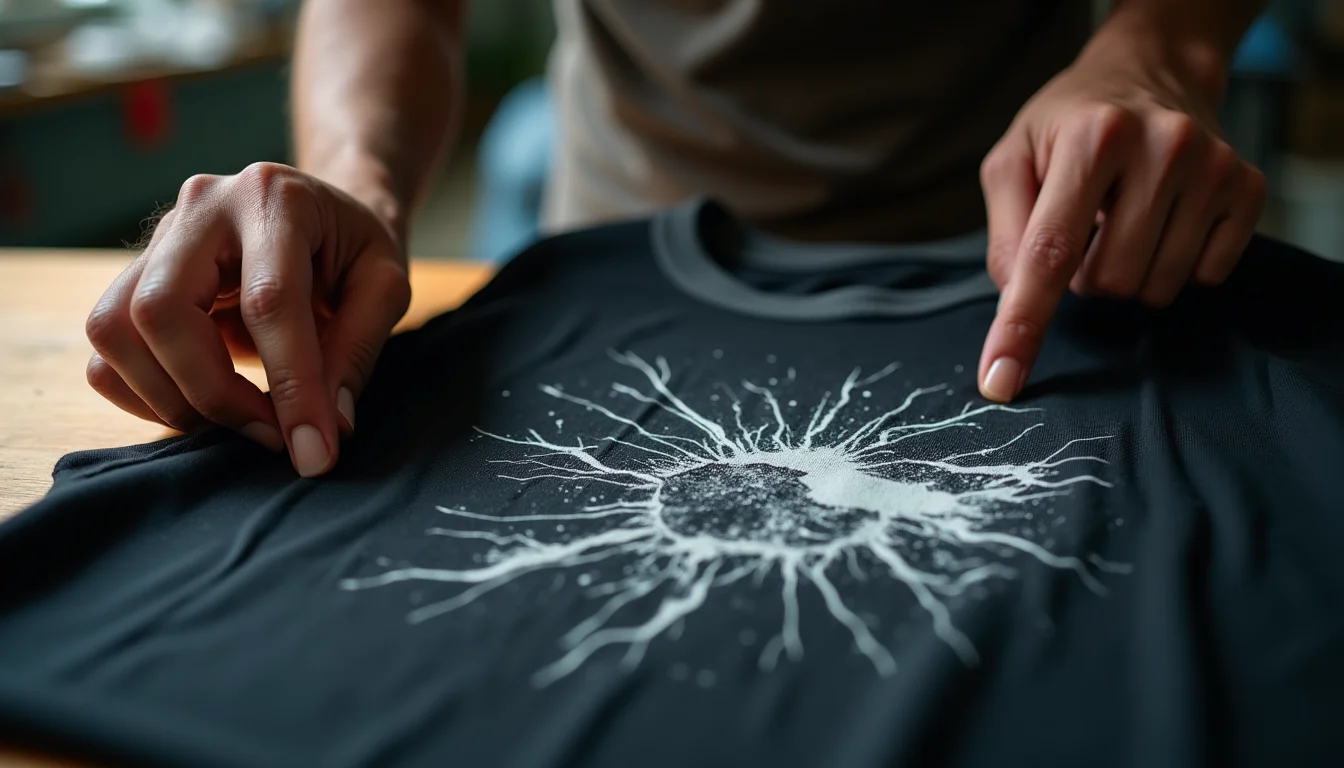
Discharge printing starts with fabric that has already been dyed to a ground colour — typically a dark shade. A chemical agent is then printed onto this pre-dyed fabric in the shape of the design. That chemical selectively destroys the dye molecules in the areas it touches, leaving those zones without colour: effectively white, or close to it, depending on the base fibre.
Source fact: "In discharge printing, fabric is first dyed to the desired ground colour, usually a dark shade, and then printed with a chemical that selectively destroys the dye, leaving a white design."
— CottonWorks: Cotton Printing Types & Techniques
The result is a design that is part of the fabric itself — the design area has no ground dye, so there is no ink film sitting above the textile surface. This is the core distinction from conventional screen printing.
The Two-Step Variant: Replacing the Ground Colour
Discharge printing has a second mode that goes one step further. Instead of simply destroying the ground dye and leaving white, the printer mixes the discharge agent together with a separate dye — one that the discharge chemical cannot affect. Both are printed simultaneously. As the discharge chemical destroys the ground colour, the new dye settles into the now-open fibre in the design area. The result is a design in a completely different colour from the ground, achieved in a single pass.
Source fact: "Alternatively, a discharge agent is printed together with a dye that the agent does not affect, so that dye replaces the ground colour in the design."
— CottonWorks: Cotton Printing Types & Techniques

The Critical Constraint: Not Every Ground Colour Can Be Discharged
This is the point that trips up buyers. The discharge mechanism depends entirely on the chemistry of the dye used to create the ground colour of the fabric. Some dyes are "dischargeable" — the chemical agent can break them down selectively without harming the fibre. Others are not. Attempting to discharge a non-dischargeable ground colour either produces an incomplete, patchy lift or requires extraordinary means that risk damaging the fabric itself.
Source fact: "Ground colours must be chosen that can be selectively destroyed without extraordinary means and without damaging the fabric."
— CottonWorks: Cotton Printing Types & Techniques
This means the colour of the t-shirt alone — navy, black, forest green, burgundy — tells you nothing about whether it will discharge cleanly. Two t-shirts dyed to visually identical shades of navy can behave completely differently under a discharge agent if they were dyed with different dye classes. The dischargeable property is a characteristic of the dye, not the visible colour.
It is also worth noting that discharge printing carries higher production costs compared to normal printing techniques, which is a factor to weigh when assessing quotes from your printer.
The Buyer Decision: What to Confirm Before You Order
Given everything above, the right sequence for a bulk discharge print order is not to pick a dark t-shirt and assume any dark shade will lift cleanly. The confirmation step must happen first.
Before ordering blanks for a discharge print run, ask your printer directly: "Can you confirm this specific fabric and ground colour will discharge cleanly with your process?" A printer working with discharge regularly will be able to test a sample swatch before you commit to a large quantity. If you have not yet ordered the blanks, sharing a swatch or the fabric specification with the printer at this stage is the right move.
This is the same principle that applies more broadly whenever the printing method interacts with fabric composition — for example, understanding how fabric blends affect DTG results follows the same logic: the fabric and the printing process must be matched deliberately, not assumed compatible.
Pre-Order Confirmation Checklist for Discharge Printing
Use this checklist before finalising your blank t-shirt order for a discharge print job:
| Question to Confirm | Why It Matters | Who to Ask |
|---|---|---|
| Is the ground colour of this specific fabric dischargeable? | Not every dark shade can be lifted cleanly; dye class determines this, not the visible colour | Your printer (request a swatch test) |
| Is the discharge a white-only result, or will a replacement colour be printed simultaneously? | Two different techniques — white discharge vs. discharge with replacement dye — affect the final look and process complexity | Your printer / design brief |
| Has the printer tested this specific fabric + discharge agent combination before? | Results vary; prior experience with your specific blank reduces risk of fabric damage | Your printer |
| Have you requested a pre-production strike-off or test print? | Confirms colour lift, design sharpness, and fabric integrity before full run | Your printer, before bulk production |
Discharge vs. Conventional Dark-Fabric Printing: A Mechanism Comparison
To make the distinction concrete, here is how discharge printing differs mechanically from the two most common alternatives for printing on dark fabric:
| Property | Discharge Printing | Plastisol / White Underbase Screen Print | DTG on Dark Fabric |
|---|---|---|---|
| What creates the design? | Ground dye is chemically destroyed in design area | Ink layer deposited on top of fabric | Ink layer deposited (white underbase first) |
| Does ink sit above fabric surface? | No (dye is removed, not ink added) | Yes | Yes |
| Ground colour compatibility? | Only dischargeable dye classes work cleanly | Works on most ground colours | Fabric composition affects ink adhesion |
| Production cost vs. normal printing? | Higher | Standard baseline | Varies by setup |
For buyers who have been considering fabric composition alongside printing method, it is worth noting that the choice of fibre and blend has implications across all printing techniques — a topic covered in more detail in the guide on choosing cotton for printing.
Sourcing Blank T-Shirts for Discharge Printing
If you are planning a discharge print run, your starting point is a blank t-shirt whose ground colour has been confirmed as dischargeable by your printer. The composition and dye specifications of the fabric matter here — not just the visual colour or GSM. (For a quick orientation on fabric specs like GSM and pre-shrunk treatment, see the FAQ guide.)
Sale91.com stocks blank t-shirts in a range of dark ground colours from its Tiruppur manufacturing base and Delhi warehouse. Check the live catalogue for current colour options, compositions, and availability — stock and specifications should always be verified on the live catalogue rather than assumed from any article, since these details change.
When ordering blanks intended for discharge printing, share the fabric specification (not just the colour name) with your printer before placing your order. This is the step that separates a clean print run from a costly reject batch.