How to Check T-Shirt GSM at Home — 220 GSM vs 160 GSM Fraud Exposed for Bulk Buyers

The label said 220 GSM. The invoice said 220 GSM. But the moment you pick up the shirt, something feels off — it's too thin, too flimsy, clearly not the same weight you print on every day. You're holding what feels like a 160 GSM shirt, and you've already placed a bulk order.
This is not a rare edge case. In the plain t-shirt wholesale trade — especially when buying from traders, resellers, or unknown online listings — GSM mislabeling is a real and recurring problem. And for printing businesses running DTF, screen print, or heat transfer, the GSM of your blank t-shirt isn't just a number on a tag. It directly affects ink absorption, print durability, and ultimately what your end customer thinks of your brand.
For a quick overview of what GSM means and how it relates to bio-washing and pre-shrinking, see our FAQ guide — here we'll go straight into the detection methods.
The core problem: Most buyers trust the label and only discover the mismatch after delivery. By then, you've paid, you've signed, and chasing a refund from a distant supplier is painful. The solution is to verify GSM yourself — before you commit to full quantity, or at least at the sample stage. Here are three methods that actually work.
Why GSM Mislabeling Happens in the Bulk T-Shirt Market
Understanding the "why" helps you know who to trust and what to watch for. The plain t-shirt supply chain in India has multiple layers — fabric mills, yarn traders, knitting units, dyeing units, cutting and stitching units, wholesalers, and resellers. By the time a shirt reaches a printing business in, say, Jaipur or Bengaluru, it may have passed through four or five hands.
At each layer, there is an incentive to cut costs. Knitting thinner fabric (say, 160 GSM) and labeling it as 220 GSM allows a supplier to charge a premium price while using cheaper raw material and less yarn per shirt. The weight difference between a 160 GSM and 220 GSM shirt sounds small in grams, but across a 500-piece order it represents a significant reduction in cotton used — which translates directly into lower input costs for the supplier and a worse product for you.
Manufacturers who knit their own fabric in-house — like our Tiruppur unit, where we operate our own knitting machines and control GSM from yarn to finished garment — have no incentive to mislabel. The fabric weight is set at the knitting stage and can be verified at any point. But when you're buying from a trader who sources from multiple fabric lots, the actual GSM can vary batch to batch, and the label simply reflects what was ordered, not necessarily what was delivered.
This is also why GSM consistency matters as much as GSM accuracy. Suppose you order 500 pieces — some rolls from the batch may genuinely be 220, others may be 190 or 200 from a different lot. You end up with a mixed-weight shipment labeled uniformly as 220 GSM. For a printing business, this inconsistency creates visible differences in print results across the same order run.
GSM Quick-Reference: What to Expect From Each Weight
Before you learn to measure, you need to know what you're measuring for. Here is a decision table built from our actual product range — the GSM values we manufacture and the use cases each weight is suited to. Use this as your benchmark when evaluating any supplier's claims.
| GSM | Feel / Drape | Best For | Print Compatibility | Our Verdict |
|---|---|---|---|---|
| 160 or below | Very thin, almost see-through when held to light | Summer innerwear, disposable promo tees | Poor — ink bleeds through, print lacks opacity | ❌ Not for printing |
| 180 GSM | Light, breathable, some body | Everyday casual wear, summer merchandise | Acceptable for DTF and screen print with proper settings | ⚡ Entry level |
| 200 GSM | Medium weight, has structure, holds shape | Premium casual, branded merchandise, uniforms | Good — solid base for DTF, DTG, heat transfer, screen print | ✔ Standard choice |
| 210 GSM | Noticeably heavier, smooth finish | Premium retail, corporate gifting | Excellent — ink sits cleanly, no bleed-through | ✔ Premium range |
| 220 GSM | Solid, structured, feels expensive in hand | High-end merchandise, export orders, streetwear | Excellent — best opacity, color vibrancy, wash durability | ✔ Heavy premium |
| 240 GSM+ | Dense, hoodie-level weight | Sweatshirts, hoodies, oversized drop-shoulder styles | Specialised — check our hoodie and sweatshirt range | ✔ Heavy garments |
If a supplier delivers 160 GSM when you ordered 220 GSM, you're receiving a product that falls entirely in the "not for printing" category. The print will look washed out, the shirt will feel cheap to the end customer, and your repeat order rate will suffer — none of which shows up on the supplier's radar.
3 Practical Ways to Check GSM at Home — No Lab Required
You don't need a textile testing lab or expensive equipment. The three methods below can be done with tools you either already have or can buy inexpensively. Use all three together for the most reliable result — any two pointing to the same conclusion is sufficient confidence before placing a large order.
The Cut-and-Weigh Test (Scale Method)
This is the most objective method because it uses math, not feel. GSM stands for Grams per Square Metre — it literally tells you how many grams one square metre of that fabric weighs. You can back-calculate it from a small sample.
What you need: A digital kitchen scale (accurate to 0.1g), a ruler, and scissors.
Step 1: Cut a square piece of fabric that is exactly 1 foot × 1 foot (30.48 cm × 30.48 cm). Use a ruler and be precise — even a 1 cm error will throw off your reading. Cut from a flat panel (front or back), avoiding seams and hems.
Step 2: Weigh this square on your digital scale. Note the weight in grams. Let's call it W.
Step 3: Multiply W by 10.76.
GSM = W (grams) × 10.76
The factor 10.76 is because 1 square metre = 10.76 square feet. So if your 1 sq ft sample weighs 20.4 grams, your fabric GSM is approximately 220 GSM (20.4 × 10.76 ≈ 219.5). If it weighs 14.9 grams, you're holding roughly 160 GSM fabric.
Tolerance note: Allow ±5 GSM variation due to moisture content and cutting precision. A reading of 215–225 is acceptable for a 220 GSM claim. A reading of 155–165 for a claimed 220 GSM shirt is clear mislabeling.
The Reference Sample Comparison (Feel Test — Done Right)
The "feel test" gets dismissed because most people do it wrong — they rely on vague memory. The correct version uses physical reference samples that you keep permanently in your workspace.
How to build your sample kit: Order one shirt each at 180, 200, and 220 GSM from a verified manufacturer. Label each clearly with a permanent marker on the tag. Iron them flat and store them in a zip-lock or small folder. This becomes your reference library.
Using the kit: When a new batch arrives, take the suspect shirt and press it flat alongside your 220 GSM reference. Hold both between your fingers at the same point on the garment (chest panel works best). Press — don't just grip. The difference between 160 and 220 GSM is immediately obvious once you've calibrated your hands against known samples:
- 160 GSM: Feels hollow, collapses easily under light pressure, almost crinkles like paper
- 180 GSM: Has some body but still feels lightweight, breathable
- 200 GSM: Noticeably more resistance, holds its shape when you let go
- 220 GSM: Solid, dense feel — presses back against your fingers, doesn't collapse
This method is fast and portable — you can use it at a wholesale market or trade fair without any equipment. The key is having calibrated samples; without them, the feel test is unreliable.
When evaluating fabric for colour retention after printing, the feel comparison also gives you a good first-pass sense of whether the fabric has been properly bio-washed — genuine bio-washed fabric has a smooth, slightly silky surface that heavier GSM amplifies.
The Light Test (Transparency Check)
This is not precise enough to distinguish 200 from 220, but it is an excellent quick screen to catch the worst cases — shirts below 180 GSM being passed off as 200+ GSM.
How to do it: Hold the shirt up against a bright light source — natural window light works best, or a bright LED lamp. Spread the fabric flat and look at the front panel.
- If you can clearly see the outline of your hand or fingers through the fabric — you're looking at sub-180 GSM material. Almost certainly 160 or below.
- If the light passes through but you can't see clear shapes — you're in the 180–200 GSM range.
- If the fabric appears largely opaque and you have to hold it very close to the bulb to see any light — you're at 200+ GSM.
A genuine 220 GSM cotton shirt held against standard indoor lighting should show no transparency at all. If it does, stop right there and run the scale test before going further.
The light test is also useful when checking pre-shrink consistency across a batch — fabric that's been improperly pre-shrunk tends to have uneven tension visible when backlit.
Pre-Order GSM Verification Checklist for Bulk Buyers
This is a checklist we've developed specifically for printing businesses ordering blank t-shirts in bulk — whether it's 50 pieces or 5,000. Use it before committing to any large quantity from a new supplier.
- Request a paid sample (even 1–2 pieces) before confirming bulk quantity — any serious supplier will allow this
- Run the cut-and-weigh test on the sample; acceptable range is claimed GSM ±5
- Compare sample against your reference fabric kit (180, 200, 220 GSM samples)
- Do the light test — no transparency should be visible in 220 GSM under normal indoor light
- Check if the supplier manufactures their own fabric or resells — ask directly, or check if they have a production unit
- Verify that fabric is bio-washed and pre-shrunk — ask for a wash test: a non-pre-shrunk shirt will shrink 4–8% after first wash
- Check the fabric composition label: should say 100% Cotton (Ring-spun Combed), not just "Cotton" which may include blends
- For large orders (500+ pieces), ask if the shipment comes from a single fabric lot to ensure GSM consistency throughout
- If ordering online, check that the platform or seller has a verifiable physical address and GST registration
Why GSM Accuracy Matters So Much for Printing Businesses
For end consumers, a 160 GSM vs 220 GSM shirt might just be a comfort preference. For a printing business, it's the difference between a profitable run and a write-off. Here's why:
DTF and Screen Print: GSM Affects Ink Adhesion
In Direct-to-Film (DTF) printing, the adhesive powder bonds to the fabric surface. A thinner, lower-GSM fabric has less surface structure and tends to have more loose fibres, which weakens adhesion over multiple washes. If you're printing on what you believe is 220 GSM but is actually 160 GSM, your prints will fade faster — and that becomes your reputation problem, not the t-shirt supplier's.
For screen printing, ink laydown and opacity depend heavily on fabric weight. A 160 GSM shirt will allow ink to bleed through to the inside of the garment on white or light-base prints — especially with plastisol inks. The ink also sits differently on thinner fabric, resulting in a less vibrant, less durable print. If you're running a DTF operation and notice inconsistent results, checking fabric GSM is one of the first diagnostics to run — for the same reason we highlighted in our guide on mixing print methods in a single order, where fabric weight mismatches compound the problem significantly.
Customer Returns and Repeat Orders
Suppose you order 500 pieces of 220 GSM for a corporate merchandise client. You print, deliver, and the client starts getting feedback from their team that the shirts feel thin and cheap. They expected a premium feel — that's what 220 GSM implies. Now you face a potential return, a reputation hit, and a lost repeat client. The issue originated at the sourcing stage, but the consequences land at your door.
Export Orders Have Zero Tolerance
If you're producing for export — whether to the Middle East, Europe, or Southeast Asia — GSM accuracy is even more critical. International buyers run their own fabric tests as part of quality assurance. A batch that ships with incorrect GSM may be rejected at the destination, creating logistics and financial complications. At our manufacturing unit in Tiruppur, we ship export orders via both courier and sea freight, and every batch is verified at the knitting stage — GSM is set at the machine, not estimated afterwards.
How Sale91.com Guarantees GSM Accuracy — From Knitting to Delivery
We're not a trader or reseller. At Sale91.com, we knit our own fabric in-house at our Tiruppur manufacturing unit. This means GSM is a controlled input, not an estimate. Here's why that matters for you as a buyer:
- GSM is set at the knitting machine: We run separate knitting specifications for 180, 200, 210, and 220 GSM. The machine tension, yarn count, and stitch density are calibrated per GSM requirement — this is how you ensure consistency, not by checking after the fact.
- Same-lot dispatch: For bulk orders, we ship from the same fabric lot so GSM is uniform piece to piece. Our Delhi warehouse (Khanpur, South Delhi) maintains 1 lakh+ pieces in ready stock at any given time — sorted by GSM, colour, and size.
- Ring-spun combed cotton: Our yarn specification itself contributes to GSM consistency. Ring-spun combed cotton has more uniform fibre alignment than carded yarn, which means the knitted fabric has a more predictable weight per unit area.
- Bio-washed and pre-shrunk — verified: These two processes are done on 100% of our stock. Bio-washing (enzyme treatment) reduces pilling and softens the fabric surface; pre-shrinking stabilises the GSM post-wash so the number you buy is the number you keep.
We sell to 1,25,232+ pieces worth of printing businesses every month across India — DTF studios, screen print shops, heat transfer operations, and custom merchandise brands. GSM accuracy is non-negotiable because our buyers' print quality depends on it.
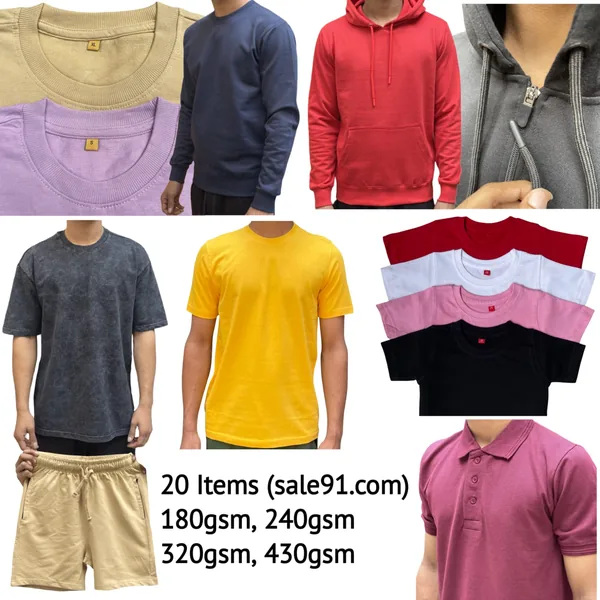
Our product range on GSM: We manufacture plain round neck t-shirts in 180, 200, 210, and 220 GSM; oversized t-shirts; polo t-shirts; acid wash tees; and hoodies & sweatshirts in 240, 320, and 430 GSM. You can browse the full product catalog here. MOQ starts at 10 pieces for ready stock items.
Ordering Smart: What to Do Before and After the GSM Test
Running the GSM check is step one. Here's the full protocol for a safe bulk order:
Before Ordering
- Always order a sample first — even 10 pieces is a valid test quantity
- Run all three GSM checks on the sample before approving the bulk quantity
- Confirm with the supplier whether the stock is from a single knitting lot or mixed lots
- Check MOQ and whether partial quantities are available — at Sale91.com, you can start from as low as 10 pieces
When Placing the Bulk Order
- Get the GSM specification in writing on the invoice or order confirmation
- For new suppliers, consider 50% COD on the first order to reduce financial risk (we offer 50% COD on first orders, +3% COD charge applies)
- Orders of 500+ pieces qualify for ₹2/piece discount at Sale91.com; online orders get an additional ₹3/piece discount regardless of quantity
- Check if the supplier can ship PAN India or handles export logistics if needed
On Delivery
- Do not unpack the entire shipment before running spot checks on 5–10 random pieces from different cartons
- Rerun the cut-and-weigh test on at least two pieces from different parts of the shipment
- If any pieces fail the GSM check, document everything (photos, weights, invoice) before contacting the supplier
Watch the Video
Watch this quick YouTube Short for a visual walkthrough of all three GSM checking methods — the cut-and-weigh test, the reference feel comparison, and the light transparency check: