Lockstitch vs Chain Stitch in Bulk Plain T-Shirts — Which Seam Holds?
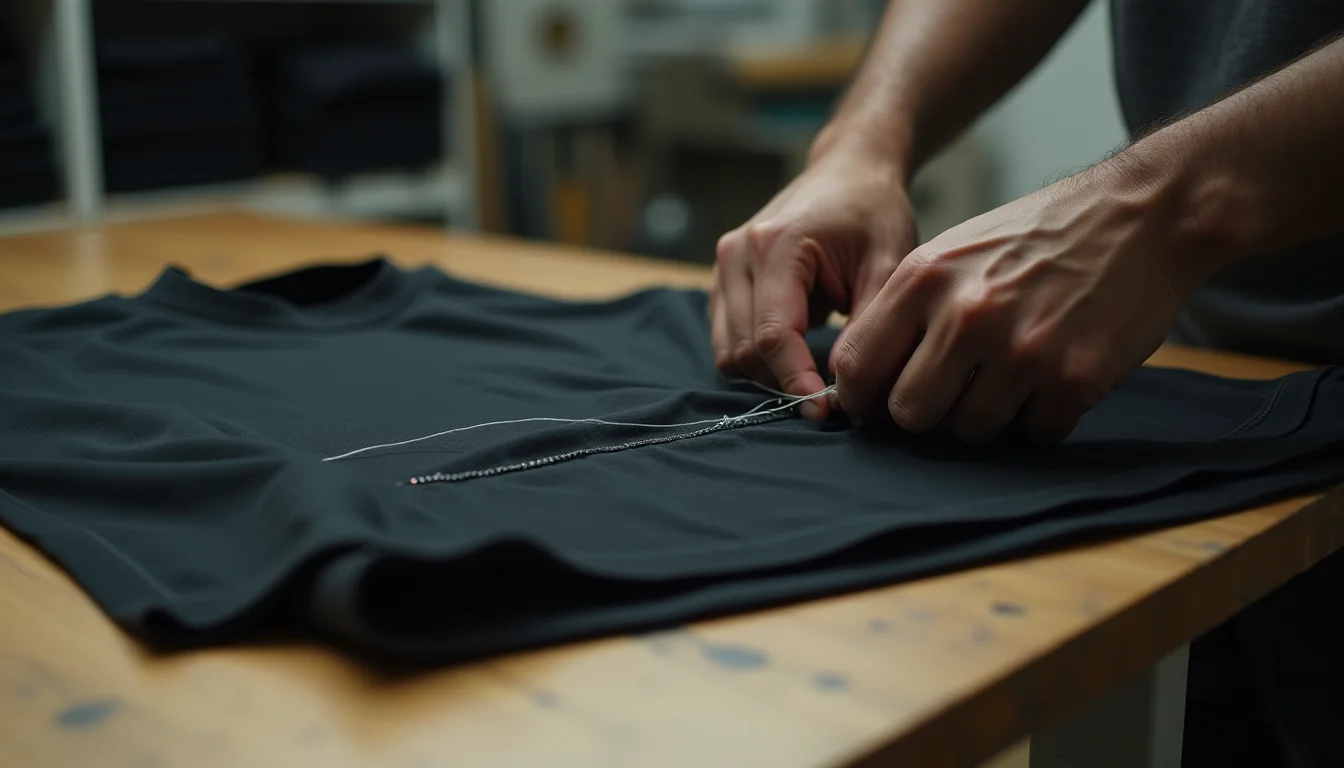
When you source plain t-shirts in bulk for DTG, screen printing, DTF, or heat transfer work, you check fabric weight, colour consistency, and whether the shirt is bio-washed. (Quick primer on those fabric basics: see the FAQ page.) But the one quality variable that most buyers overlook until a seam opens in the field is the type of stitch used to sew the garment together.
Two stitch families — lockstitch and chain stitch — behave in completely opposite ways when a single thread breaks. Understanding that difference is not academic; it directly affects whether a 500-piece or 5,000-piece order survives repeated washing, printing pressure, and daily wear. This article covers the mechanics of each stitch, where each is (and is not) appropriate on a t-shirt, how to measure and evaluate stitch density, and a practical step-by-step seam inspection you can do yourself on any sample before you commit to a bulk run.
1. What Is a Lockstitch?
A lockstitch is formed by two separate threads: a needle thread fed from above the fabric and a bobbin thread running beneath the needle plate. The needle pierces the fabric, creates a loop, and the bobbin hook catches that loop and pulls it tight around the bobbin thread. The result is a symmetrical, interlocked knot at every single stitch point. Because the lock is formed independently at each stitch, a single broken thread does not propagate — the seam stays intact on both sides of the break.
This is the stitch you see on industrial single-needle and double-needle sewing machines. It produces a clean, flat line on both the face and underside of the fabric. Its main limitation: the bobbin must be changed or refilled frequently, which slows down very high-speed production compared to chain-stitch machines.
2. What Is a Chain Stitch?
A chain stitch uses only the needle thread (or needle thread plus one looper thread, depending on the subtype). The needle passes through the fabric, forms a loop, and on the next stitch the needle passes through that previous loop — creating an interlocked chain of loops on the underside of the seam. There is no independent bobbin lock at each point.
The critical mechanical consequence: because each loop depends on the next loop to hold it, if you pull the free tail of a broken chain-stitch thread, the seam can unravel like a zipper all the way back from the break point. This "ladder run" is a known and accepted trade-off of chain-stitch construction — it is not a defect per se, but it is a risk that buyers handling large quantities must understand before specifying or accepting garments.
3. Where Each Stitch Is Normally Used on a T-Shirt
A single t-shirt is actually assembled using several different stitch types — often three to five distinct machine types pass over different parts of the garment. Here is the standard breakdown:
| Seam / Location | Typical Stitch Type | Why This Stitch Here |
|---|---|---|
| Shoulder seam | Lockstitch (double-needle) or overlock | High-stress area; must not unravel; lockstitch gives clean flat finish |
| Side seam | Overlock (5-thread safety stitch) or flatlock | Knitwear stretches; overlock trims, joins, and encases the edge in one pass |
| Sleeve attachment | Overlock or chain stitch on linking machine | Curved seam requires stretch and speed; linking gives clean finish |
| Bottom hem | Chain stitch (single or double needle) or coverstitch | Speed on long straight run; coverstitch gives two top rows + one looper row |
| Neck rib attachment | Overlock or chain stitch on ribbing machine | Rib must stretch 2× when pulled over head; chain/overlock accommodates stretch |
| Neck tape (shoulder-to-shoulder tape) | Lockstitch single needle | Tape stabilises the seam; lockstitch holds tape flat without bulk |
| Label attachment | Lockstitch | Precision placement; must not unravel even when label is torn |
The fact that chain stitch is commonly used at the hem by design is what surprises many first-time bulk buyers. It is not a cost-cutting shortcut — hem chain stitch is industry-standard because the hem runs in a long unbroken line, the stitch is backtacked at both ends to secure the chain, and the sewing speed advantage on that straight run is significant in a factory producing tens of thousands of pieces daily. The risk appears when the backtack is skipped or poorly done, leaving a free tail that can be pulled.
4. Why Overlock and Flatlock Are Used on Knitwear — and How They Relate
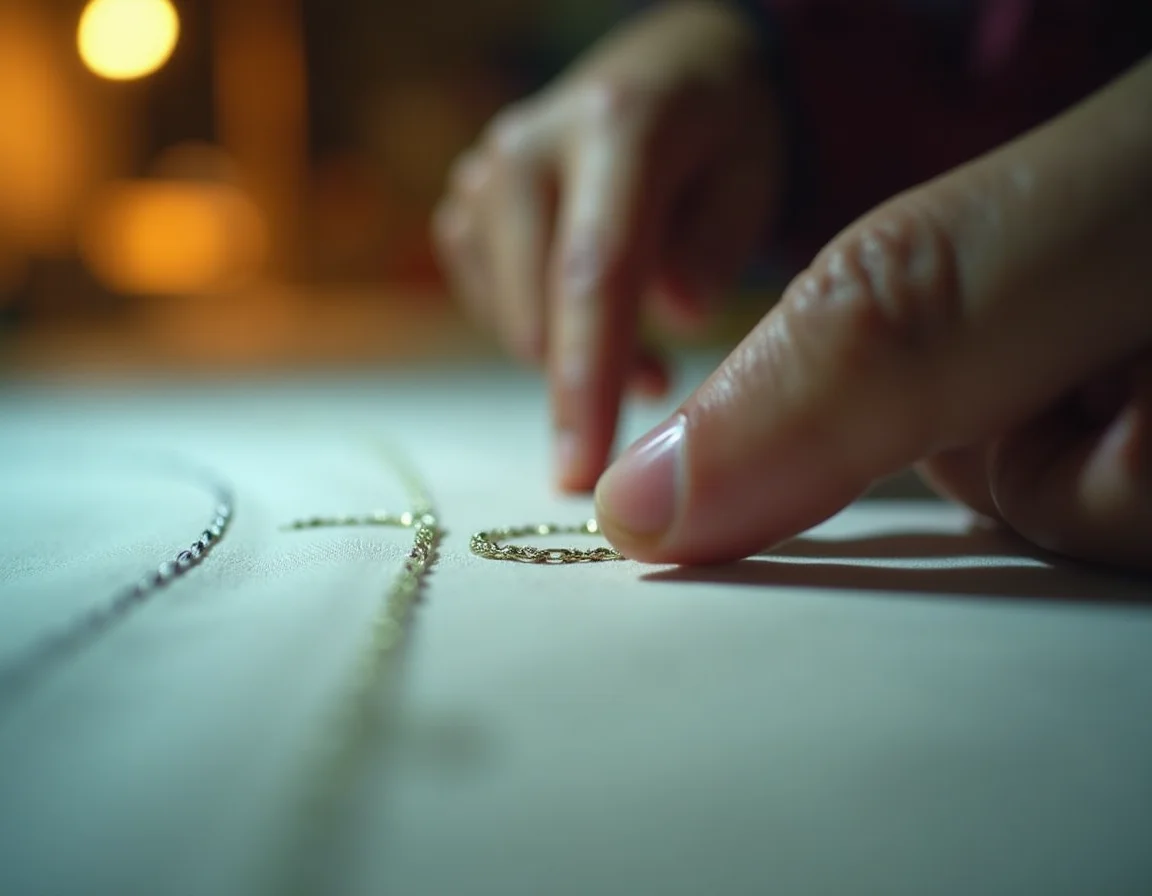
Plain t-shirts are made from knitted fabric — a structure of interlocked yarn loops — rather than woven fabric. Knit fabric stretches in multiple directions; a rigid woven-fabric seam on a knit garment would snap the moment you put it on or reach your arms up. This is why most t-shirt seams use one of two stretch-compatible finishing stitches:
Overlock (Serger Stitch)
An overlock machine uses 3, 4, or 5 threads simultaneously. It trims the raw fabric edge, wraps thread around that edge, and joins two fabric panels in a single pass. The resulting seam has a slight ridge on the inside of the garment. A 5-thread safety overlock adds a chain-stitch component alongside the overlock, giving both edge security and seam strength. Overlock is essentially a specialised form of chain-based looping — which means it too has a degree of loop dependency, but because the looper threads wrap the fabric edge, partial unraveling is contained at the edge rather than racing along the seam length.
Flatlock (Flatseam)
A flatlock machine — also called a flatseam or flat-seam machine — joins two fabric panels edge-to-edge so the seam lies completely flat. The looper thread decorates the face side and the needle thread locks underneath. Flatlock seams are used in athletic and performance wear where side-seam bulk causes skin irritation or print surface irregularity. For printing businesses, a flatlock side seam means a truly flat printing surface all the way to the edge — relevant if you are printing designs that bleed near the seam. Flatlock is loop-dependent like chain stitch, but the geometry of the seam makes spontaneous unraveling far less likely in normal wear.
For buyers evaluating t-shirt stitching quality in bulk orders, understanding the stitch type is the first step — before you even pick up the seam to test it.
5. Stitches Per Inch (SPI) — What It Is and What Range to Expect
Stitches per inch (SPI) is exactly what it sounds like: the number of individual stitch cycles in one linear inch of seam. A higher SPI means more thread penetrations per inch, a tighter seam, better seam strength per unit length, and less chance of seam gaping. It also means more thread consumption and marginally longer sewing time.
A lower SPI produces a looser seam that may gape or pucker under stress. Critically, for chain-stitch seams at the hem, a very low SPI means fewer loops per inch — so if unraveling starts, it travels faster through fewer, larger loops.
Here are the industry-accepted SPI ranges for knit garment construction:
| Seam Type / Location | Acceptable SPI Range | Recommended for Premium Bulk T-Shirts |
|---|---|---|
| Lockstitch (shoulder, label, tape) | 10 – 14 SPI | 12 – 14 SPI |
| Chain stitch (hem, bottom) | 8 – 12 SPI | 10 – 12 SPI |
| Overlock / Safety stitch (side seam) | 12 – 16 SPI (needle row) | 14 – 16 SPI |
| Coverstitch (hem, collar) | 8 – 12 SPI | 10 – 12 SPI |
| Flatlock (side seam, athletic) | 12 – 16 SPI | 14 SPI |
To measure SPI yourself: place a ruler along any seam on the garment sample. Count the number of needle penetration points (small dots or indentations in the thread line) in exactly one inch. If a seam that should read 12 SPI reads 7 or 8, that is a production shortcut worth flagging before bulk approval.
6. The Critical Practical Difference: Why a Broken Chain-Stitch Thread Is a Bigger Risk
This is the central trade-knowledge point that every bulk buyer should internalise:
Chain stitch: Thread breaks at stitch #247. If the free tail of the broken thread is present and tension is applied, stitches #248, #249, #250 … can cascade open because each loop relied on the next loop for retention. The seam does not hold forward of the break.
This "zipper failure" of chain stitch is not theoretical — it is a known, documented property of the stitch geometry. The garment industry manages it through two safeguards:
- Backtacking: At the start and end of every chain-stitch seam, the machine reverses for 4–6 stitches, creating a locked end that prevents the cascade from starting at the seam tail.
- Thread trimming: After backtacking, the thread tail is trimmed close. A long loose tail left hanging from a hem is the single most common cause of chain-stitch seam failure in the field.
When checking a sample, locate the hem stitch start and end points. Look for visible thread tails. If you see a tail of more than 5mm and the backtack is poor or absent, that seam is vulnerable. A well-made bulk t-shirt will have clean, short thread ends with firm backtacks on every chain-stitch run.
For perspective on how thread selection (not just stitch type) affects seam durability at scale, the general principles around thread quality in bulk t-shirt stitching are worth understanding alongside stitch mechanics.
7. Seam Pucker, Thread Tension, and Why They Matter to Printers
What Is Seam Pucker?
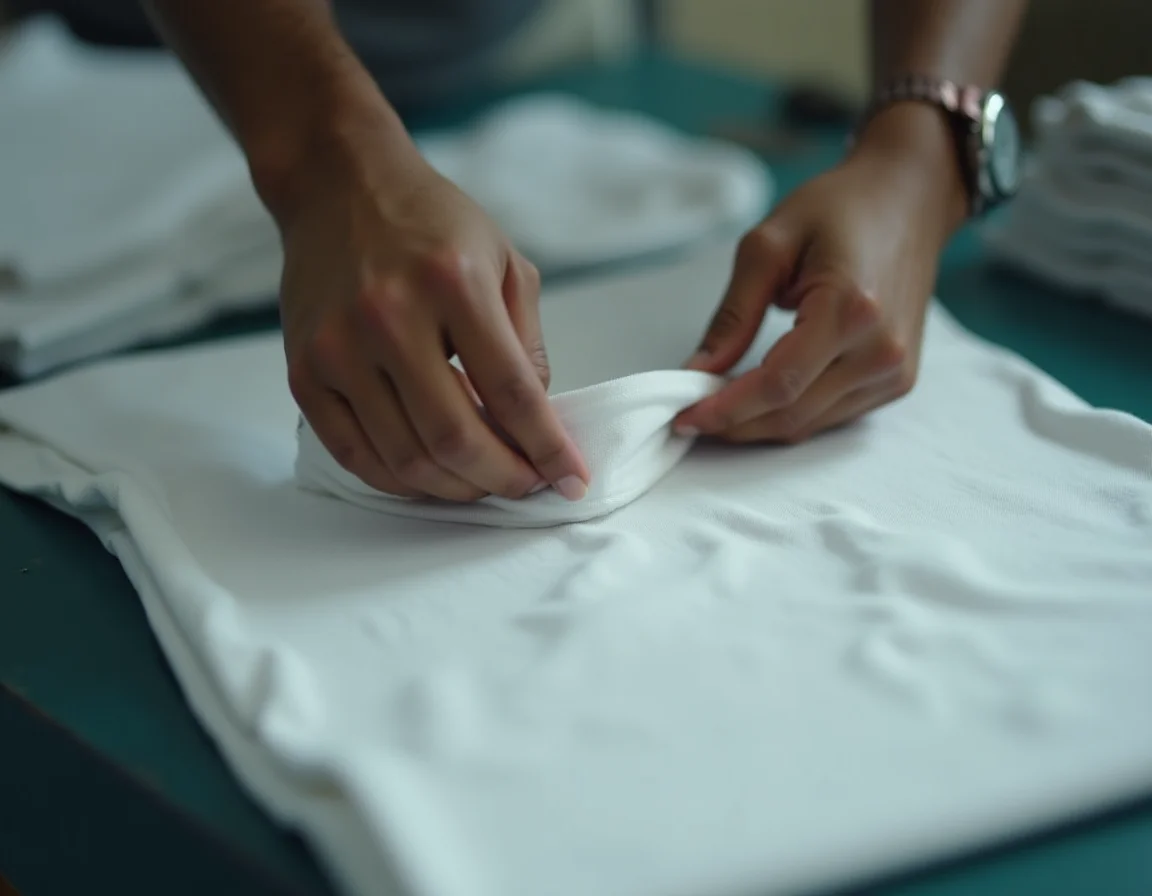
Seam pucker is the rippled, gathered appearance a seam develops along its length. It is caused by incorrect thread tension, incorrect presser foot pressure, differential fabric feed, or using a thread count mismatched to the fabric weight. On a 200 GSM or 220 GSM cotton t-shirt, a puckered seam means the fabric surface is not flat — which directly affects print quality on DTG and screen printing.
Thread Tension — What to Look For on a Sample
Ideal thread tension means the needle thread and bobbin thread (on lockstitch) meet exactly in the middle of the fabric thickness. If needle tension is too loose, the needle thread loops appear on the underside; if it is too tight, the bobbin thread is pulled to the face side. Either condition weakens the mechanical lock at each stitch point and causes the seam surface to look uneven.
To evaluate tension: hold the seam up to a light source and look at both faces. On a lockstitch seam, both faces should show an identical straight line with no loops visible. On a coverstitch hem, the face should show two clean parallel rows; the underside should show the looper thread running in clean zigzag loops — not pulled tight or hanging loosely.
When examining samples from a manufacturer's range spanning different GSM — for example, the 180 GSM everyday-weight and the 220 GSM premium-weight t-shirts available at Sale91.com — check whether the thread weight and tension spec is adjusted proportionally across GSM variants. A thread tensioned for 180 GSM fabric running on 220 GSM fabric will produce over-tight seams; the reverse produces loose loops. A quality manufacturer calibrates per GSM, not per style.
8. How GSM Interacts With Stitch Specification
GSM is not just about hand feel or print substrate quality — it also directly determines the correct stitch specification for that garment. Here is how the Sale91.com product range maps to stitch considerations:
| Product / GSM | Fabric Thickness Implication | Stitch Consideration |
|---|---|---|
| Round Neck T-shirt 180 GSM | Lighter, more flexible | Lower SPI acceptable; tension must be lighter to avoid pucker |
| Round Neck T-shirt 200 / 210 GSM | Mid-weight, printing standard | 12–14 SPI lockstitch shoulder; 10–12 SPI chain hem; balanced tension |
| Round Neck / Oversized 220 GSM | Heavy premium | Higher thread count needed; presser foot pressure must increase to avoid skipped stitches |
| Hoodie / Sweatshirt 240–430 GSM | Very thick; multi-layer at pockets | Heavy-duty needle (size 14–16); chain stitch replaced by lockstitch at stress points |
| Acid Wash T-shirt (regular/oversized) | Enzyme-altered surface; can be slightly uneven | Overlock seams must be re-checked after wash; acid process can stress seam thread |
Buyers sourcing across multiple GSMs from the BulkPlainTshirt.com product catalog should request a sample of the specific GSM they intend to print on and conduct the seam checks below on that specific weight — not on a lighter sample used as a substitute.
If you are deciding between 200 GSM and 220 GSM for a printing order and wondering whether the weight alone determines quality, the nuances around GSM versus yarn quality are directly relevant to how seam stress is distributed across the fabric.
9. The Seam Inspection Checklist: What to Do With Every Sample
Below is a step-by-step physical inspection you perform on any t-shirt sample before approving a bulk order. This checklist is designed for the four critical seam zones of a standard plain t-shirt.
🔍 Bulk T-Shirt Seam Quality Inspection — 4-Zone Checklist
Zone A: Shoulder Seam (Lockstitch / Overlock)
- Run your thumbnail along the seam length. It should feel firm and uniform — no gaps or loose thread loops.
- Count SPI in a 1-inch section: should be ≥12 for a standard round-neck tee.
- Grip fabric on both sides of the shoulder seam and pull firmly in opposite directions. The seam should not gap more than 2–3mm, and should return to original position when released.
- Check for neck tape on the underside of the shoulder seam. The tape should lie flat, with no puckering or bubbling — indicating correct lockstitch tension on tape attachment.
Zone B: Side Seam (Overlock / Flatlock)
- Turn the shirt inside out. An overlock seam should show a clean, uniform looped edge — no loose threads hanging from the trimmed edge.
- Check the seam width: a consistent 5–7mm overlock seam indicates machine calibration. Inconsistent width means the operator was not feeding fabric evenly.
- For a flatlock seam, check the face side: two parallel thread lines with no gaps. Underside should show consistent looper zigzag.
- Pull the side seam laterally (parallel to the seam line) as if the shirt is being stretched across the body. The seam should stretch without the stitches snapping.
Zone C: Bottom Hem (Chain Stitch / Coverstitch)
- Chain stitch specific: Locate both ends of the hem stitch. Check for backtack (a reversed, dense cluster of stitches at the start and end). If no backtack is visible, the hem is at risk.
- Check for thread tails: any tail longer than 5mm at the hem ends should be flagged.
- Count SPI on the hem: should be ≥10. Run your nail against the hem from end to end — you should feel even resistance, not intermittent gaps.
- To test: grip the hem and pull it gently away from the body of the shirt. The hem should not separate from the fabric. Then release — the hem should lie flat without puckering.
- Critical test for chain stitch unraveling risk: If you can find a small cut thread tail at the hem end (on a test sample you are willing to sacrifice), try to pull it. If the stitches cascade open easily past the backtack, the backtack is insufficient.
Zone D: Neck Rib and Neck Tape Attachment
- Stretch the neck opening fully — to at least 1.5× its relaxed circumference — and hold for 5 seconds. The neck rib seam should not pop, crack, or show visible thread stress.
- Release: the neck opening should return to its original shape. If it stays stretched or the seam gapes, the neck rib attachment (typically overlock or chain) is either under-tensioned or the rib fabric ratio is incorrect.
- Check the interior neck area for the shoulder-to-shoulder tape. The tape should be sewn flat with a single or double lockstitch line. Any puckering of the tape indicates tension mis-set on that lockstitch run.
- If a label is present: the label stitching (lockstitch) should be flush. Tug the label corner firmly. A well-applied lockstitch label does not begin to lift from the corner pull.
Run this checklist on at least three samples from the same batch — not just one. Production variation can mean the first sample sewn after machine calibration is perfect, but pieces 50 and 500 in the run drift slightly. If all three samples pass, the production is consistent.
10. Sale91.com's Manufacturing Approach: In-House Knitting, Tiruppur Factory
Most plain t-shirt suppliers in India are traders — they source fabric from a mill, get the garments cut and sewn at a separate unit, and pass them through a warehouse. The stitch specification is whatever the CMT (cut-make-trim) contractor delivers, with no direct control over machine setup.
Sale91.com operates differently: fabric is knitted in-house at the Tiruppur manufacturing facility, meaning the GSM, yarn count, and fabric construction are controlled at the yarn stage. When the same manufacturer who knits the fabric also sets the stitch specification for cutting and sewing, thread tension can be calibrated to the exact fabric weight being sewn that day — not to a generic setting used for whatever fabric arrives from an outside vendor. The result is a consistent match between fabric thickness and seam specification across all GSM variants from 180 up to the 430 GSM hoodie range.
For B2B buyers ordering 500+ pieces, the ₹2/piece bulk discount and ₹3/piece online purchase discount available at Sale91.com mean that a properly spec'd garment costs less per piece than it would from a trader sourcing piecemeal — with the added assurance that seam quality is set at manufacturing, not at inspection.
New buyers also have access to a 50% COD option on first orders (with a 3% COD charge), which allows you to physically inspect the delivered pieces — running the checklist above on actual production samples — before committing to full prepaid orders.
Watch: Plain T-Shirt Quality Explained
Frequently Asked Questions
More Articles



Ready to Order Plain T-Shirts With Verified Seam Quality?
Sale91.com ships 1 lakh+ plain t-shirts every 30 days from our in-house Tiruppur knitting facility and Delhi Khanpur warehouse. MOQ starts at 10 pieces for ready stock, with ₹2/pc discount on 500+ quantity orders and ₹3/pc off on all online purchases. New buyers get 50% COD on the first order so you can inspect before committing to full prepaid.
Order on Sale91.com →