Low Margin High Volume T-Shirt Business — ₹15 Profit × 10,000 Pcs = ₹1.5 Lakh Monthly Reality

There is a conversation that happens constantly inside printing business WhatsApp groups, across trade counters in Tiruppur, and in the back offices of screen printing studios across India: "Yaar, margin bohot kam hai." ₹15 per piece sounds small. It sounds like you are working for almost nothing. But when you multiply that number by volume — real, consistent, monthly volume — the story changes completely.
This article breaks down the margin vs. volume debate in the t-shirt printing business with real numbers, a decision framework you can actually use, and a concrete comparison table built from the product reality at Sale91.com — India's manufacturer-direct source for blank t-shirts. No invented customer stories, no padded anecdotes — just the math and the strategy.
₹50 margin × 500 pieces = ₹25,000 per month.
Which business would you rather run?
The Margin Obsession That Costs Printing Businesses Growth
Most printing business owners are taught — often by well-meaning mentors — to protect their margin at all costs. "Never go below ₹X profit per piece." That advice comes from a retail mindset, not a B2B volume mindset. When you are selling custom-printed t-shirts to corporates, event organizers, colleges, or resellers who order in hundreds or thousands, the economics are entirely different.
The obsession with per-piece margin causes a specific and very common mistake: quoting high to protect margin, losing the order entirely, and ending the month with zero revenue from that client. A ₹0 order generates ₹0 profit regardless of how good your margins would have been.
This connects directly to a pricing mistake that many printers make when dealing with bulk inquiries — quoting MRP rates for bulk orders instead of building a volume-based pricing structure. Both mistakes come from the same root cause: not understanding how the economics of scale work in this trade.
The Two Business Models Side by Side
The difference is not just income — it is operational stability, client retention, and the ability to plan your blank t-shirt procurement, ink costs, and labour in advance. High-volume clients make your business predictable. Predictability is the foundation of scale.
Understanding Your Client Type Before Setting Margin
Not every client is the same. The margin you keep should be a function of who is buying, how much they buy, and how often they reorder. There are broadly two client archetypes in the custom printing business:
The ₹80 Client
This is the price-sensitive bulk buyer — a college committee ordering 500+ pieces for a fest, a small brand ordering plain tees in bulk for resale, or a corporate HR team placing an annual uniform order. They have done their research. They know blank t-shirt wholesale rates. They are comparing three quotes simultaneously. For this client, your margin needs to be lean and your service needs to be sharp. Winning a ₹80-per-piece order on 2,000 pieces is far more valuable than losing it while holding out for ₹120.
The ₹300 Client
This is the premium buyer — a boutique brand, a streetwear label, an NRI startup looking for quality exports, or a corporate gifting company that needs heavy GSM, acid wash, or oversized fit. This client is buying the experience, the quality, the finish, and the brand story behind the garment. Here, a ₹50 to ₹100 margin per piece is entirely reasonable because volumes are lower but the client relationship is sticky and long-term.
The fundamental error many printers make is applying a single fixed margin to every client type. The ₹300 client and the ₹80 client require different pricing logic, different blank t-shirt selection (from our 180 GSM everyday range to our 220 GSM heavy premium range), and different communication styles.
Margin–Volume Decision Matrix for Printing Businesses
The table below is built using the real GSM range, MOQ, and pricing structure available through Sale91.com. Use it as a practical planning tool when quoting for new clients:
| Client Type | Blank T-Shirt GSM | Suggested Order Qty | Realistic Margin/Pc | Monthly Revenue (if consistent) | Strategy |
|---|---|---|---|---|---|
| College / Event Bulk | 180 GSM | 500–2,000 pcs | ₹15–₹25 | ₹30,000–₹1,50,000+ | Volume play, fast turnaround |
| Corporate Uniform | 200 GSM | 300–1,500 pcs | ₹25–₹45 | ₹37,500–₹90,000 | Repeat annual orders, relationship |
| Reseller / Wholesale | 180–200 GSM | 1,000–10,000 pcs | ₹10–₹20 | ₹60,000–₹2,00,000 | Low margin, very high volume |
| Premium Brand / D2C | 220 GSM / Oversized | 100–500 pcs | ₹50–₹120 | ₹25,000–₹60,000 | High margin, lower volume |
| Export / International | 200–220 GSM | 500–5,000 pcs | ₹30–₹80 (USD margin equivalent) | ₹50,000–₹2,50,000 | Best of both — margin + volume |
| Streetwear / Acid Wash | Acid Wash / 220 GSM | 50–300 pcs | ₹80–₹150 | ₹20,000–₹45,000 | Niche, premium, slow growth |
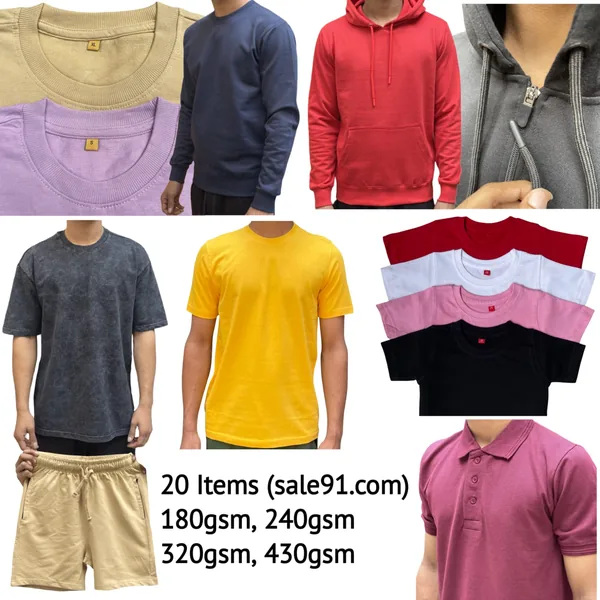
This matrix is the kind of planning tool that separates businesses that scale from those that stagnate. The data reflects our real product range — from 180 GSM everyday wear to 220 GSM heavy premium, plus oversized and acid wash variants — all available with MOQ starting at just 10 pieces for ready stock items at Sale91.com.
Why Low Margin Is Not the Same as Low Profit
This is the conceptual shift that everything else hinges on. Margin per piece and total profit are different numbers. Confusing them is what keeps printing businesses small.
Suppose you order 500 pieces of a 200 GSM plain t-shirt at ₹180 per piece from a manufacturer-direct supplier. You print and sell them at ₹205 each — a ₹25 margin. Your total gross profit: ₹12,500. Now suppose a competitor orders the same 500 pieces, tries to keep a ₹60 margin, quotes ₹240, loses the order to you, and ends the month with ₹0 from that client type. Who wins?
The compounding effect of volume is dramatic. At 10,000 pieces per month — which is entirely achievable for an established printing studio with two or three corporate or reseller clients — even a ₹15 margin generates ₹1,50,000. That is a sustainable, bankable business income. It also means you are procuring blank t-shirts at scale, which itself unlocks further savings.
How Blank T-Shirt Procurement Directly Shapes Your Margin
Your profit margin is determined not just by what you charge — it is equally determined by what you pay for your blanks. This is where manufacturer-direct sourcing changes the entire economics of the printing business.
BulkPlainTshirt.com (Sale91.com) is not a trader or reseller. We knit our own fabric in-house at our Tiruppur manufacturing facility — India's textile manufacturing capital — and maintain a 1 lakh+ piece ready stock at our Delhi warehouse in Khanpur, South Delhi. That means no middleman margin is embedded in your blank cost. What you pay is what the manufacturer charges, not what a distributor marks up and passes on.
For a printing business running on tight margins, this difference is not cosmetic — it is structural. Suppose the blank t-shirt trader price is ₹195 for a 200 GSM bio-washed tee. If our manufacturer-direct price is ₹182 for the same spec, you have just found ₹13 of margin without changing your print price at all. At 10,000 pieces monthly, that ₹13 difference is ₹1,30,000 — almost an entire month's profit recovered from procurement efficiency alone.
All our t-shirts are 100% Cotton, bio-washed, pre-shrunk, and made from ring-spun combed cotton — the specs that matter for print quality and client satisfaction. For a quick reference on what these specs mean for your print output, see our product FAQ page.
The Cost-Per-Piece Breakdown at Different Volume Tiers
| Order Quantity | Base Discount Available | Effective Saving/Pc | Monthly Saving at This Volume |
|---|---|---|---|
| 10–499 pcs (ready stock) | ₹3/pc online purchase discount | ₹3 | ₹30–₹14,970 |
| 500+ pcs | ₹2/pc quantity + ₹3/pc online = ₹5/pc total | ₹5 | ₹2,500–₹50,000+ |
| 10,000+ pcs/month | ₹5/pc baseline + relationship pricing | ₹5+ | ₹50,000+ |
The Real Operational Checklist: Running a High-Volume Printing Business
High volume is not something that happens by accident. It requires deliberate operational structure. Here is a step-by-step checklist — original to this article — for printing businesses looking to move from ad-hoc orders to 5,000–10,000 pcs/month consistency:
High-Volume Printing Business Operations Checklist
- Step 1 — Segment your clients: Identify which clients are volume clients (event, corporate, reseller) vs. premium clients (brands, exports). Apply different margin logic to each.
- Step 2 — Lock in blank t-shirt stock agreements: Coordinate with your blank supplier for rolling stock availability. At Sale91.com, 1 lakh+ pieces are in ready stock at any time — plan your procurement around this rather than ordering reactively.
- Step 3 — Build a monthly volume target, not a per-order target: If your goal is ₹1.5 lakh/month at ₹15 margin, work backward to 10,000 pcs. Break that into client commitments, not hope.
- Step 4 — Use the 500-piece threshold strategically: Structure your quotes to encourage clients above 500 pieces — this is where the procurement discount kicks in, widening your effective margin without raising prices.
- Step 5 — Manage colour and size mix proactively: With 15+ colours available across our range, agree on colour mix with clients in advance. Late changes on bulk orders create production delays and revenue gaps.
- Step 6 — Plan for COD on new client relationships: Sale91.com offers 50% COD on first orders (with a 3% COD charge). Use this to manage cash flow when onboarding new high-volume clients whose payment timelines are unclear.
- Step 7 — Track margin by client segment monthly: Do not average all clients together. Know your per-segment margin. If your premium segment drops in volume, your average margin rises but total income may fall.
- Step 8 — Reinvest volume savings into capacity: The ₹5/pc saving from volume procurement should feed back into printing equipment, labour, or marketing — not just bank balance. Growth requires reinvestment.
When High Margin IS the Right Strategy
This article is not an argument against high margin — it is an argument against applying high-margin logic to the wrong client type. There are genuine scenarios where keeping ₹80–₹150 per piece margin makes complete business sense:
- Premium fabric orders: When a client specifies 220 GSM, oversized fit, acid wash finish, or hoodie/sweatshirt in 320–430 GSM, they are paying for product differentiation. Margin here is justified and expected.
- Rush turnaround orders: If a client needs 200 pieces in 48 hours, your speed has value. Price it accordingly.
- Full branding packages: If you are providing design, printing, packaging, and delivery as a bundled service, your margin on the garment itself is part of a larger service fee.
- Low-reorder clients: A client who orders once a year and is unlikely to reorder should not get volume pricing. Give them a fair market rate.
Understanding the difference between a fabric-quality mistake and a pricing mistake is also critical. For instance, if a client receives t-shirts that smell after dyeing or fade after the first wash, no margin — high or low — protects your reputation. Quality of the blank is a non-negotiable foundation, which is why stitching quality checks on bulk orders matter as much as margin planning.
The Export Opportunity: Where Margin and Volume Can Both Be High
One segment that printing businesses in India consistently underutilise is the export client. BulkPlainTshirt.com ships via courier and sea transport to international buyers — and the economics of export orders are often the most attractive combination of decent volume and better per-piece value.
An international buyer ordering 2,000 pieces of a 200 GSM bio-washed plain tee at a price point that translates to ₹280–₹350 per piece leaves room for a ₹60–₹100 margin while still being competitively priced in their home market. For a printing business acting as an export intermediary or a custom-print export house, this is a significant revenue stream.
The key is blank quality consistency — which is why in-house fabric knitting (as opposed to sourcing from different fabric mills on each order) is a competitive advantage that directly affects your ability to serve export clients at scale. Browse the full product range at BulkPlainTshirt.com/catalog/ to see GSM options and variants relevant to export requirements.
The Compound Effect: What Happens When You Stay Consistent for 12 Months
Let us play the long game on paper. Suppose a printing business consistently sells 10,000 pieces monthly at a ₹15 net margin. Over 12 months, that is ₹18,00,000 in gross profit from the printing margin alone — before accounting for procurement savings, service bundling, or client upgrades.
Now suppose that over those 12 months, 3 of those volume clients upgrade from 180 GSM to 200 GSM, increasing the sale price and therefore the margin by ₹8–₹10 per piece. The volume stays the same but the margin per piece rises naturally — not because you pushed it, but because the client relationship matured and the client saw value in the quality upgrade.
This is the compounding logic of low-margin, high-volume strategy: volume creates the client relationship, and the client relationship eventually supports better margin. You cannot rush to ₹50 margin with a new client. But you can earn it over time once you are their trusted supplier.
One common trap to avoid during this growth phase is letting cost-cutting decisions erode the quality that built the relationship in the first place. The instinct to save a few rupees on blank cost by switching to a cheaper source mid-scale is a mistake — as illustrated by how a small procurement decision can unravel an entire client base, much like what happens when a small saving destroys a print business.
Watch the Video
This article expands on a YouTube Short that broke down the ₹15 × 10,000 margin reality in under 60 seconds. Watch it below:
Frequently Asked Questions
More Articles


Ready to Order Blank T-Shirts for Your Printing Business?
Join 1,25,232+ pieces worth of printing businesses that sourced blank tees from India's manufacturer-direct supplier last month. Available in 180, 200, and 220 GSM — bio-washed, pre-shrunk, 100% ring-spun combed cotton. MOQ from just 10 pieces on ready stock. PAN India delivery and export shipping available.
Order Blank T-Shirts at Sale91.com →