Same GSM, ₹60 Ka Farak — Why an ₹80 Plain T-Shirt and a ₹140 Plain T-Shirt Can Weigh Exactly the Same (Carded vs Combed Yarn, Explained)

You place two plain white t-shirts side by side. Both say 200 GSM on the tag. You put them on a weighing scale — identical weight. But one is priced at ₹80 per piece and the other at ₹140 per piece. A ₹60 difference. Your first instinct: someone is lying.
Nobody is lying. But somebody is hiding something — and that something is the yarn.
If you run a t-shirt printing business — whether you do DTG, DTF, screen printing, or heat transfer — this is the single most important fabric fact you need to understand before you place your next bulk order. Getting this wrong does not just hurt your margins. It hurts your print quality, your customer satisfaction, and your repeat business.
Let's break it down completely.
What GSM Actually Tells You (And What It Doesn't)
GSM stands for Grams per Square Metre. It is a measure of how much the fabric weighs per unit area. A 200 GSM fabric weighs 200 grams for every square metre of cloth. That's it. That's the entire definition. For a broader primer on GSM, bio-wash, and pre-shrunk basics, see our FAQ page — here we're going deeper into what GSM does not tell you.
GSM tells you how dense the fabric is. It does not tell you what the fabric is made from, how the fibers were processed, or how the yarn was spun. Two fabrics can have the exact same GSM and still feel completely different, print differently, pill differently, and last for different lengths of time — because the yarn underneath is different.
This is why a buyer who weighs both shirts and declares the price gap "a scam" is making a logical error — they are measuring the right thing but concluding the wrong thing. Weight alone is not the full story.
The Three Yarn Types You Will Encounter in Plain T-Shirt Wholesale
To understand the price gap, you need to understand how cotton yarn is made — specifically the difference between carded cotton, combed cotton, and ring-spun cotton. These are not marketing labels. They describe actual manufacturing steps in the yarn production process.
1. Carded Cotton — The Economy Tier
Raw cotton fibers come in all lengths — long, medium, and short. They also arrive tangled, with impurities mixed in. Carding is the first major cleaning step: the raw cotton is passed through a series of fine wire teeth that disentangle the fibers and remove the largest impurities. The output is a relatively uniform web of fibers that gets twisted into yarn.
The key limitation of carded yarn: it retains short fibers and some impurities. Short fibers do not bond as well with their neighbors. Over time — and especially after washing — they loosen from the yarn surface and form little balls of fiber on the fabric. This is called pilling. The fabric surface becomes rough and uneven.
For print businesses, pilling creates another specific problem: uneven print adhesion. When the fabric surface is not smooth and uniform, ink or transfer film cannot bond consistently across the surface. The result is prints that look patchy, fade unevenly, or crack earlier than expected.
Carded yarn is cheaper to produce because it skips the extra processing steps. That cost saving gets passed down the supply chain — and that's why carded-yarn t-shirts land at ₹80 or similar price points in the wholesale market.
2. Combed Cotton — The Mid-to-Premium Step
After carding, combed cotton goes through an additional step: combing. In this process, the fiber bundle is passed through fine-toothed combs that specifically remove short fibers and remaining impurities, keeping only the longest, strongest fibers. Think of it as a quality filter applied after the initial cleaning.
The result is a yarn made of longer, more uniform fibers. This yarn is smoother to the touch, stronger under tension, and significantly more resistant to pilling. The fabric surface stays cleaner longer — which is exactly what you want if you're putting prints on it.
3. Ring-Spun Cotton — The Gold Standard for Print Blanks
Ring-spinning is a spinning method (not a fiber processing step, but it often follows combing). In ring-spinning, the fibers are continuously twisted and drawn out in a ring frame, creating a tighter, more compact yarn. The resulting yarn is softer, smoother, and more durable than open-end or rotor-spun yarn made from the same fibers.
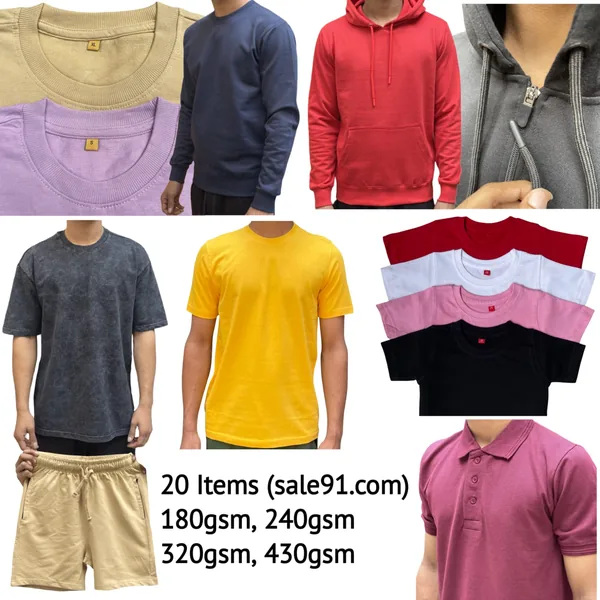
When you combine combing + ring-spinning, you get combed ring-spun cotton — the premium standard for plain t-shirts used in printing applications. This is what Sale91.com uses across its entire product range, from the 180 GSM everyday t-shirts all the way up to the 430 GSM hoodies.
Carded vs Combed Ring-Spun: A Complete Spec & Decision Table
The table below is built from actual production parameters and print-business use cases — not marketing copy. Use it to evaluate any blank t-shirt supplier's claims before placing a bulk order.
| Factor | Carded Cotton | Combed Ring-Spun Cotton |
|---|---|---|
| Fiber length retained | Short + long fibers mixed Lower | Only long fibers kept Higher |
| Surface smoothness | Slightly rough, textured Economy | Smooth, uniform, near-silky Premium |
| Pilling risk | High — short fibers loosen with washing High | Low — long fibers stay bonded Low |
| DTG / DTF print quality | Uneven adhesion, patchy results possible Risk | Clean, consistent ink/film bonding Reliable |
| Screen print sharpness | Slightly reduced edge definition Moderate | Sharp, crisp edge detail High |
| Wash durability (print) | Print fades/cracks faster due to surface change Lower | Print holds longer on stable surface Higher |
| Shrinkage after wash | Higher if not pre-shrunk Risk | Lower; pre-shrunk + bio-wash adds control Controlled |
| Typical wholesale price range | ₹70–₹95 per piece (200 GSM approx.) Economy | ₹120–₹160 per piece (200 GSM approx.) Premium |
| GSM appearance | Same as combed on scale Identical | Same as carded on scale Identical |
| End-use recommendation | Promotional giveaways, short-lifecycle uses Limited | Retail, custom printing, brand merchandise Recommended |
This table is the reason you should never evaluate a blank t-shirt on GSM and price alone. The row that matters most for print businesses is print quality — and that row is determined entirely by yarn type, not GSM.
Why This Matters Specifically for Printing Businesses
If you are in the custom t-shirt printing business — whether that's DTG printing, DTF transfers, screen printing, or heat transfer — the substrate (the blank t-shirt) is half your product. The print is the other half. Both halves need to be right for your customer to be happy.
How Carded Yarn Affects Your Prints
Carded yarn creates a slightly uneven fiber surface at the microscopic level. For DTG printing specifically, the ink is deposited directly onto that fiber surface. When the surface is uneven — with short fibers sticking up at odd angles — the ink deposits unevenly. The result can be a print that looks slightly dull, has inconsistent saturation, or develops micro-cracks at the fiber tips after the first few washes.
For DTF transfers, the adhesive layer bonds to the fabric surface. A rougher, more porous carded surface can create inconsistent bonding — you might see lifting at the edges of the transfer, especially after washing. This is compounded if the buyer washes the garment inside-out at higher temperatures.
For screen printing, the ink sits on top of the fibers. Carded yarn's slightly raised fiber texture can slightly reduce the sharpness of fine lines and small text — particularly in multi-color halftone designs where precision matters. If you've noticed that the same design looks crisper on some blank shirts than others, yarn type is likely the variable you haven't been tracking.
Understanding how yarn quality affects your finished product is the same principle that explains why two vendors with the same color can look completely different — substrate quality is always the hidden variable.
The Shrinkage Connection
Carded yarn also has a higher natural shrinkage rate because the shorter, loosely bonded fibers can shift and contract more when exposed to heat and moisture. Suppose you order 500 pieces of a carded-yarn 200 GSM shirt for a uniform printing project. If those shirts have not been properly pre-shrunk, the finished garments could end up smaller than the size spec — which means returns and reprints. At scale, this is a serious cost risk.
Combed ring-spun cotton, especially when combined with proper bio-washing and pre-shrinking (as done by manufacturers like Sale91.com), has much tighter dimensional stability. The size you receive is the size that survives the wash.
Why the Price Gap Is ₹60 — A Manufacturing Breakdown
The ₹60 per piece difference between an ₹80 carded-yarn shirt and a ₹140 combed ring-spun shirt is not arbitrary. It reflects real cost differences across the production chain:
- Raw fiber cost: Long-staple cotton fibers suitable for combing cost more at the ginning stage. Carded yarn uses a wider mix of fiber lengths, including lower-grade short fibers, which are cheaper.
- Combing process: Combing machines add a processing step that consumes time, energy, and creates waste (the short fibers removed in combing are not usable in the same yarn — they are sold as lower-grade material). This adds to the per-kg cost of yarn.
- Ring-spinning machinery: Ring-spinning frames are slower than rotor/open-end spinning equipment. Producing the same weight of ring-spun yarn takes more machine-hours, which directly raises the cost per kilogram of yarn.
- Yarn to fabric to garment: Premium yarn increases fabric cost, which increases per-piece garment cost. Add bio-washing (enzyme treatment for smoothness), pre-shrinking, and quality finishing — and the gap compounds to ₹50–₹70 per piece depending on GSM.
A Practical Buying Checklist — 6 Questions to Ask Any Blank T-Shirt Supplier
Before You Place Your Next Bulk Order, Ask:
- Carded or combed? — This is question one. If the supplier cannot answer without hesitation, that tells you something.
- Ring-spun or open-end spun? — Ring-spun is the premium option. Open-end (rotor) spun yarn is faster to produce but coarser in feel.
- Is the fabric bio-washed? — Bio-washing (enzyme treatment) further softens the fabric surface and reduces pilling tendency, especially important for DTG ink bonding.
- Is the garment pre-shrunk? — Essential for dimensional stability across washes. Ask for the shrinkage rate claim (ideally <3% after 3 washes).
- Who makes your fabric? — A manufacturer who knits their own fabric (like Sale91.com, operating out of Tiruppur) can verify yarn specs. A trader or reseller often cannot.
- Can you send a sample before bulk? — Run the "close your eyes" test. Feel the surface. Check for even weight distribution when held up to light. Do a water-drop test: on combed ring-spun, the drop spreads more evenly.
What Sale91.com Uses — Real GSM Range and Yarn Specs
At Sale91.com, our plain t-shirts — from the 180 GSM everyday round-neck tees to the 220 GSM heavy premium pieces — all use 100% combed ring-spun cotton. The same applies to our oversized t-shirts, polo t-shirts, and acid wash variants. Our hoodies and sweatshirts range from 240 GSM all the way up to 430 GSM for winter-weight fleece, all built on the same premium yarn foundation.
Every garment goes through bio-washing (enzyme treatment for softness and anti-pilling) and pre-shrinking before it reaches our warehouse. We maintain 1 lakh+ pieces in ready stock at any time — split between our Tiruppur manufacturing facility and our Delhi warehouse in Khanpur, South Delhi — so delivery timelines are not held up by production queues for standard sizes and colors.
The reason we sell 1,25,232+ pieces in a single 30-day period is not because we are the cheapest. It is because printing businesses — DTG operators, DTF studios, screen printers — have learned that a ₹60 cheaper carded shirt can cost far more when print quality complaints, returns, or reputation damage are factored in. The yarn quality is the foundation. Everything printed on top of it is only as good as that foundation.
Browse the full range and current pricing at our product catalog. Orders start from as low as 10 pieces on ready stock items, with a ₹3/piece online purchase discount for any quantity and an additional ₹2/piece off on 500+ piece orders.
Understanding these substrate differences is also relevant when you're managing more complex print orders. If you've ever had to handle multiple print techniques in a single order, you'll know that fabric quality is the one variable that affects every technique differently — getting the substrate right is non-negotiable.
Watch the Video
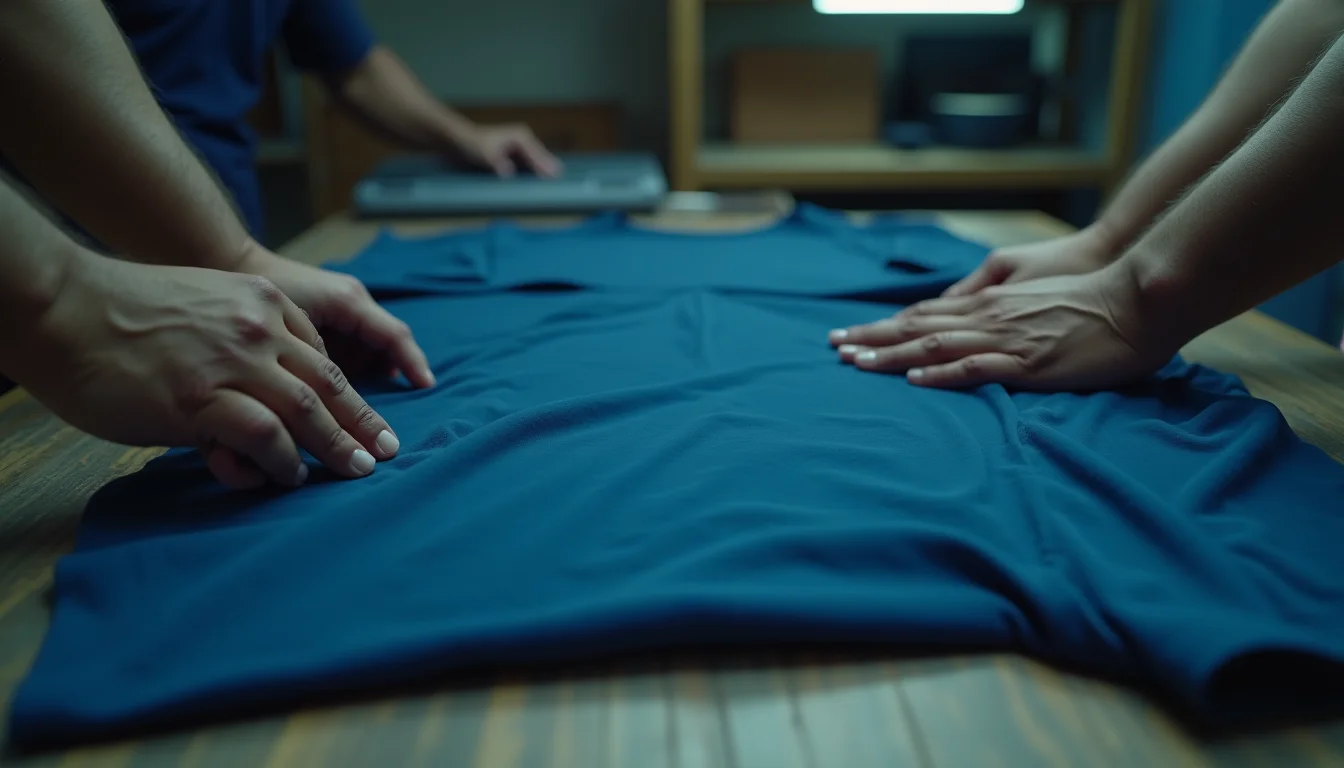
This short explains the yarn truth in under 60 seconds — with a real-time feel comparison between carded and combed ring-spun fabric:
Frequently Asked Questions
More Articles



Order Combed Ring-Spun Plain T-Shirts in Bulk
All plain t-shirts at Sale91.com are 100% combed ring-spun cotton, bio-washed, pre-shrunk, and ready for DTG, DTF, screen print, and heat transfer. 1 lakh+ pieces in ready stock. MOQ from 10 pieces. Pan-India delivery and international export available.
Order Now at Sale91.com →