240 GSM vs 200 GSM Plain T-Shirt — Why Heavier Feels Cheap and Yarn Quality Matters More

Imagine this: a customer walks into your printing shop, picks up two t-shirts, both priced at ₹80 each. One is 240 GSM — heavier, thicker, and what most people would assume is the "premium" option. The other is 200 GSM — lighter. He runs his fingers across both. The 200 GSM feels silky smooth. The 240 GSM feels rough and scratchy. He's confused. You're confused. The supplier is probably staying silent.
This is not a one-off story. This happens every single week in India's printing and custom apparel industry. Businesses buying bulk plain t-shirts get caught in what we call the GSM Trap — the false belief that higher GSM always means better quality. It doesn't. And understanding this one distinction can save your brand reputation, your customer relationships, and thousands of rupees in wasted inventory.
Let's break it all down — what GSM actually measures, why yarn type is the real quality indicator, and how to never get fooled again when sourcing blank t-shirts for DTG, DTF, screen printing, or heat transfer businesses.
What Does GSM Actually Mean in T-Shirts?
GSM stands for Grams per Square Metre. It is the weight of one square metre of fabric. A higher GSM means more material is packed into the same area, which generally translates to a thicker, heavier fabric. That's the simple textbook definition — and that's where most people stop learning.
Here's what they miss: GSM tells you how much material is in the fabric, but it says nothing about what kind of material or how it was processed. A fabric can be made denser and heavier using cheap, low-quality yarn just as easily as using premium yarn. In fact, it's often easier to inflate GSM using low-quality fibre because rough, unprocessed fibres are bulkier and heavier per unit volume.
In the Indian textile market, GSM ranges commonly used for t-shirts are:
- 180 GSM — Everyday casual wear, lightweight, breathable
- 200 GSM — Premium everyday wear, the sweet spot for most print businesses
- 210–220 GSM — Heavy premium wear, structured feel, popular for branded merchandise
- 240 GSM — Typically used for sweatshirts, hoodies, or heavy-duty apparel
- 320–430 GSM — Full hoodies and sweatshirts
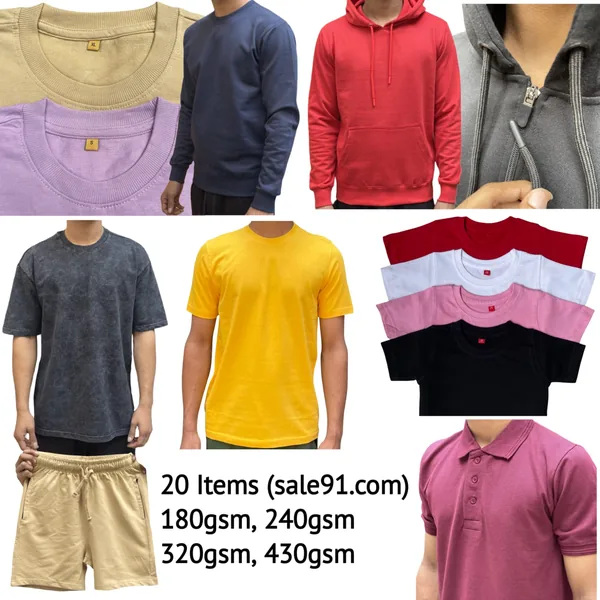
At Sale91.com, the plain t-shirt range covers 180, 200, 210, and 220 GSM in ring-spun combed cotton — which is the right way to offer GSM variety, because the yarn type is consistent and premium across all weights.
The Real Culprit: Open-End Yarn vs Ring-Spun Combed Cotton
This is the heart of the issue, and it's something most bulk buyers never think to ask about. When a supplier quotes you a 240 GSM t-shirt, your first question should not be "what's the price?" — it should be "what yarn type is this made from?"
What Is Open-End Yarn?
Open-end (OE) spinning is a faster, cheaper method of producing yarn. In this process, cotton fibres are spun using a rotor machine. The fibres aren't as tightly aligned or as consistently combed, which means the resulting yarn has:
- Shorter, irregular cotton fibres (more short-fibre waste retained in the yarn)
- A rougher, bulkier texture
- Higher tendency to pill after washing
- Slightly lower tensile strength compared to ring-spun yarn
- Lower cost — typically ₹15 to ₹20 less per kg than ring-spun yarn
Because OE yarn is bulkier and cheaper, suppliers can easily achieve a higher GSM number at a lower cost. This is exactly how a 240 GSM t-shirt can be produced and sold at the same price as a well-made 200 GSM t-shirt. The weight is there. The quality is not.
If you've ever noticed a 200 GSM fabric feeling cheap despite its weight, the yarn type is almost always the root cause — something many buyers don't discover until returns start coming in.
What Is Ring-Spun Combed Cotton?
Ring-spun yarn is made using the traditional ring-spinning method, where fibres are continuously twisted and drawn out to create a stronger, finer, more uniform yarn. When this process is combined with combing — a step that removes short fibres and impurities — you get ring-spun combed cotton, the gold standard for premium apparel fabric.
Ring-spun combed cotton features:
- Long, aligned cotton fibres with minimal short-fibre content
- Smooth, soft surface that feels premium to the touch
- Excellent resistance to pilling after multiple washes
- Higher tensile strength — seams and fabric hold longer
- Better dye uptake — colours appear richer and more vibrant
- Sharper, cleaner printing surface for DTG, DTF, and screen print
"Open-end yarn makes fabric thick but rough. Ring-spun combed cotton feels smooth, prints sharper." — This isn't just a preference. It directly affects your print business's customer satisfaction and repeat orders.
The ₹80 Example: Why Same Price Doesn't Mean Same Value
Let's revisit our real-world scenario. Two t-shirts, both at ₹80. One is 240 GSM OE yarn. One is 200 GSM ring-spun combed. How is this possible at the same price?
It comes down to raw material cost. Open-end yarn costs approximately ₹15–20 less per kilogram than ring-spun combed cotton. When you're manufacturing at scale, this is a massive saving. A manufacturer using OE yarn can pack more weight into the fabric (achieving higher GSM) while still maintaining a lower overall cost per piece. They then sell it at a market-competitive price, knowing that most buyers look at GSM on paper and assume quality.
| Feature | 240 GSM (Open-End Yarn) | 200 GSM (Ring-Spun Combed) |
|---|---|---|
| GSM (Weight) | 240 — Heavier on paper | 200 — Lighter on paper |
| Feel / Hand | Rough, scratchy, cheap feel | Smooth, soft, premium feel |
| Yarn Cost | ₹15–20/kg cheaper | Higher quality, higher cost |
| Pilling After Wash | High — pills within 5–10 washes | Low — stays smooth long-term |
| Print Sharpness | Rough surface = fuzzy prints | Smooth surface = sharper prints |
| Dye Absorption | Uneven, dull colour output | Even, rich colour saturation |
| Customer Perception | Feels cheap despite being thick | Feels premium despite less weight |
| Retail Price | ₹80 (inflated by weight illusion) | ₹80 (genuine value) |
This is why the GSM number alone is a misleading metric. Always ask: "What is the yarn type?" before evaluating GSM.
How Yarn Quality Affects Your Printing Business Directly
If you're running a DTG, DTF, screen printing, or heat transfer business, the base garment quality isn't just about how it feels — it directly impacts the quality of your printed output and your customer retention rates.
1. Print Sharpness and Detail
Ring-spun combed cotton creates a smoother, more uniform surface for ink or toner to adhere to. On an OE yarn fabric, the surface fibres are irregular and raised, causing ink to spread unevenly. Fine details in designs — thin lines, gradient effects, small text — will look noticeably sharper on ring-spun fabric. If you've ever had a customer complain that a DTG print looked "blurry" or "fuzzy," the fabric surface is often the first place to investigate, not the printer settings.
2. Pilling and Long-Term Durability
OE yarn fabrics start to pill — those small fuzzy balls that form on the surface — after just a few washes. For a custom-printed t-shirt being sold as a branded merchandise item or retail product, pilling after 5–10 washes is a brand-reputation disaster. Your customer's logo or artwork ends up on a pilled, rough-looking shirt. Ring-spun combed cotton resists pilling significantly longer due to the tighter, longer-fibre construction of the yarn. This is also why fabric quality issues after washing are often traced back to the base yarn type rather than the wash process itself.
3. Colour Vibrancy in Dyeing
The combing step in ring-spun combed cotton removes impurities and short fibres that would otherwise interfere with dye absorption. This means reactive dyes penetrate more evenly and deeply into ring-spun combed fabric. The result: richer, more vibrant base colours — important especially for dark-coloured t-shirts like navy, black, and royal blue that are popular in the print industry.
4. Customer Returns and Refund Risk
When an end-customer receives a printed t-shirt that feels rough or starts pilling after a few washes, they don't blame the dye or the machine — they blame the brand that sold it to them. And that brand blames the printing business. And the printing business, if they didn't verify yarn type, has no supplier accountability. Understanding yarn quality before you buy in bulk is a direct way to reduce your return and refund risk.
How to Identify Yarn Type When Buying Bulk T-Shirts
Most suppliers won't volunteer this information unless you ask directly. Here's a practical checklist for evaluating yarn quality before committing to a bulk order:
Ask the Right Questions
- Is this ring-spun or open-end yarn? — Any serious manufacturer will know immediately. Vague answers like "it's good quality cotton" are a red flag.
- Is the cotton combed or carded? — Combed cotton removes short fibres; carded cotton retains them. Combed = premium.
- What is the count (Ne) of the yarn? — Finer yarn counts (30s, 40s) are typically ring-spun and produce smoother, lighter-per-thread fabric.
- Is the fabric bio-washed? — Bio-washing (enzyme treatment) gives fabric a smoother, softer finish. It also helps reduce pilling in the first few washes.
- Is the fabric pre-shrunk? — Pre-shrinking ensures the GSM you're buying is the GSM your customer wears after the first wash.
Physical Tests You Can Do Yourself
- Cheek Test: Rub the fabric on your cheek. Ring-spun combed cotton feels soft. OE yarn feels slightly scratchy.
- Stretch Test: Gently stretch the fabric and release. Ring-spun fabric recovers more uniformly. OE fabric may show slightly uneven recovery.
- Light Test: Hold the fabric up to light. Ring-spun combed fabric shows a more even, consistent weave structure. OE fabric often shows slight irregularity.
- Wash Test: Request a sample and wash it 5–10 times. Check for pilling, shrinkage beyond pre-shrunk claim, and colour retention.
- Print Test: Run a DTG or DTF test print on sample fabric before bulk ordering. Compare edge sharpness on OE vs ring-spun samples.
GSM Guide for Indian Printing Businesses: Which Weight for Which Use Case?
Now that you understand yarn type is the primary quality indicator, let's put GSM back in its proper context as a secondary — but still useful — specification.
| GSM | Best Use Case | Recommended Yarn | Season Suitability |
|---|---|---|---|
| 180 GSM | Everyday casual wear, summer events, promotional giveaways | Ring-spun combed 30s | Summer / Year-round |
| 200 GSM | Premium retail, custom brand merchandise, corporate gifting | Ring-spun combed 30s/40s | Year-round |
| 210–220 GSM | Heavy premium retail, brand launches, structured fit apparel | Ring-spun combed 30s | Winter / Year-round |
| 240 GSM | Heavy-duty use, boxy/oversized styles, outerwear layering | Must be ring-spun combed — verify before buying | Winter / Autumn |
| 320–430 GSM | Hoodies, sweatshirts, fleece-lined winter apparel | Ring-spun / French Terry / Fleece | Winter |
The takeaway: for most printing businesses operating in India's climate, 200 GSM ring-spun combed cotton is the sweet spot. It's light enough for comfort in warm weather, premium enough for retail, and smooth enough for sharp, professional-quality prints. You can explore the full range in the BulkPlainTshirt.com product catalog.
Why Sale91.com Only Uses Ring-Spun Combed Cotton
At Sale91.com (BulkPlainTshirt.com), we manufacture our own fabric in Tiruppur — India's textile capital. We don't trade or resell. We knit our own fabric in-house, which means we control every stage of production: yarn selection, knitting, dyeing, bio-washing, and pre-shrinking.
Every t-shirt we make — whether 180 GSM, 200 GSM, or 220 GSM — uses ring-spun combed cotton exclusively. There is no open-end yarn in our production line. This isn't just a marketing claim; it's a manufacturing decision that reflects our commitment to serving printing businesses that depend on consistent, premium-quality blank garments to build their own brands.
- ✓ 100% Ring-Spun Combed Cotton across all GSM variants
- ✓ Bio-washed (enzyme treatment for smoothness)
- ✓ Pre-shrunk (what you buy is what your customer gets after washing)
- ✓ 15+ colours available in ready stock
- ✓ MOQ as low as 10 pieces for ready stock items
- ✓ 1 lakh+ pieces in ready stock at any time
- ✓ PAN India delivery + International export capability
We've sold 1,25,232+ pieces in just the last 30 days — to printing businesses, custom apparel brands, and wholesale buyers across India. The consistency of our yarn quality is one of the most cited reasons buyers come back for their second and third orders.
The Business Math: Why Buying Right Saves More Than Buying Cheap
Let's do a quick calculation. Suppose you order 500 pieces of 240 GSM OE yarn t-shirts at ₹80 each = ₹40,000 total. You print on them and sell them. Within two months, 20–30% of your customers report pilling or rough feel. That's 100–150 returns or negative reviews. The cost of handling returns, reprinting, customer service, and brand damage easily exceeds the ₹2–3 per piece you "saved" by buying cheaper yarn fabric.
Now compare: 500 pieces of 200 GSM ring-spun combed at ₹80 = same ₹40,000. Zero pilling complaints. Sharper prints. Happier customers. More repeat orders. The same money, but massively different business outcomes.
This also connects to a broader pricing mistake many printing businesses make — if you're unsure how to quote your bulk orders correctly, stop quoting MRP for bulk t-shirt orders and start building your pricing around actual fabric quality metrics.
▶ Watch the Video
See the 240 GSM vs 200 GSM yarn quality comparison explained in under 60 seconds — perfect for sharing with your team or supplier.